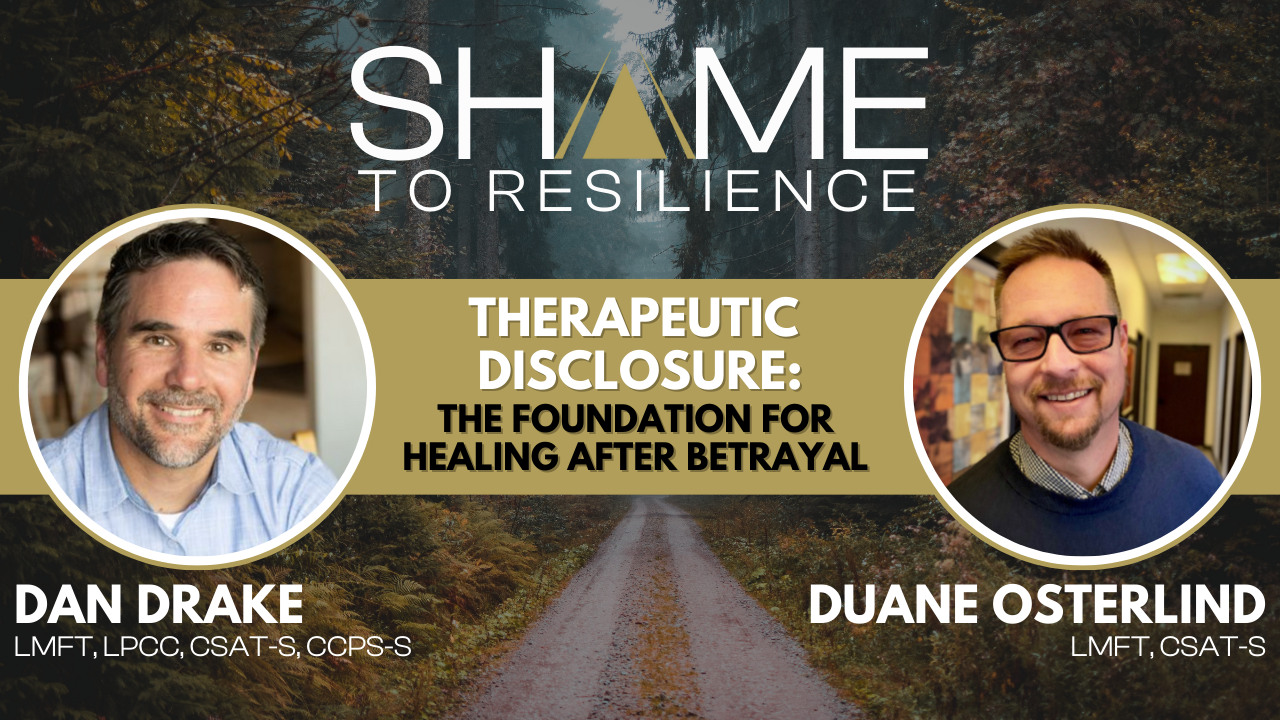
Healing After Betrayal: The Path of Disclosure

When the reality of your relationship shatters, finding a way forward can feel impossible. But true healing begins with a single, brave step: bringing the truth into the light. In our latest post, we explore the transformative power of Therapeutic Disclosure—a structured process designed not to punish, but to rebuild the broken foundation of trust.

We dive into the "pyramid of intimacy" and explain why staggering the truth only deepens the wound. Whether you are the one carrying the weight of a secret or the one reeling from discovery, this journey from shame to resilience is difficult, but you don't have to walk it alone. Discover how facing the darkness can finally lead you both back to a place of safety, honesty, and genuine connection.

[Read the full blog post to understand the steps toward healing.]
When trust is broken in a relationship, the world can feel like it has shattered. The discovery of betrayal often leaves a person feeling lost, confused, and questioning their own reality. It’s a deeply painful experience, one that can make the path forward seem impossible. But there is a way to begin rebuilding, a process that, while difficult, can create a new and more honest foundation for the future. This journey often starts with disclosure.

In a recent episode of Shame to Resilience, we explored the complex and essential role of therapeutic disclosure in healing from betrayal trauma. This process is more than just confessing; it's a structured and supported way to bring the truth into the light, allowing both partners to start fresh.

Understanding the Purpose of Disclosure

After the shock of discovering infidelity, the betrayed partner is often left with a fragmented reality. Disclosure is about piecing that reality back together. It’s not about punishing the person who was unfaithful, but about rebalancing the relationship and creating a new starting point built on truth.

Think of it as building a pyramid of intimacy. The foundation of this pyramid is honesty. Without it, nothing else can stand. From honesty, we can begin to build safety, then trust, and eventually, we can work our way up to true vulnerability and intimacy. Staggered confessions or trickle-truthing—where details come out a little at a time—constantly chip away at this foundation, making it impossible to build anything lasting. Therapeutic disclosure aims to lay all the facts out at once, creating a solid base to move forward from.

The Process of Therapeutic Disclosure

Therapeutic disclosure is not a simple conversation. It's a carefully prepared process that honors the pain of the betrayed partner while supporting the person who was unfaithful in taking full responsibility. As discussed in the episode, this process, guided by professionals, can take six to eight weeks of preparation.

For the person who has been unfaithful, this involves:

  • Writing a detailed history: This includes creating a timeline of the betrayal and investigating the behaviors without minimizing or justifying them.

  • Confronting internal narratives: The preparation phase involves multiple revisions to remove any blame-shifting, gaslighting, or rationalizations. It's about facing the truth of one's actions.

  • Preparing for the emotional impact: The goal is to present the information in a way that the betrayed partner can hear, while also preparing for the intense emotions that will follow.

For the betrayed partner, preparation involves getting ready to receive information that will be painful but will ultimately validate their intuition and reclaim their sense of reality. The truth, even when it hurts, is often less damaging than the continued deception and lies.

The Emotional Aftermath: A Post-Operative Period

Disclosure is not the finish line; it’s a new starting line. The period immediately following disclosure can be incredibly challenging. It can be compared to the post-operative period after major surgery. Things will likely feel worse before they start to get better.

The person who was unfaithful often experiences a mix of immense relief from no longer carrying the secret, alongside a deep terror of the consequences. For the betrayed partner, this is when the true grieving process begins. They are now processing the full scope of the betrayal and mourning the relationship they thought they had.

It is in this tender, post-disclosure phase that the real work of rebuilding begins. It requires patience, professional support, and a commitment from both individuals to navigate the pain together.

The Role of Shame in Healing

A powerful force that keeps betrayal hidden is shame. Secrecy and hiding only reinforce shame, creating a cycle that is incredibly difficult to break. Disclosure, on the other hand, is an act of bringing shame into the light. Through sharing and taking responsibility, healing can begin.

This is a profound experience for the person who was unfaithful. Confronting their shame is often one of the most significant benefits of the disclosure process, allowing them to move toward genuine change.

But shame isn't limited to one person. The betrayed partner may also experience shame—shame for not seeing the signs sooner, or shame for choosing to stay in the relationship. Acknowledging and working through these feelings is a critical part of their healing journey as well. Disclosure helps the betrayed partner reclaim their reality, validating that what they suspected was real and allowing them to trust their intuition again.

Find a Path Forward

The journey through betrayal is one of the most difficult challenges a relationship can face. But you don't have to walk it alone. The process of disclosure, when done with professional help and support, can be a transformative step toward healing and creating a relationship grounded in honesty and respect. It offers a chance to not just repair what was broken, but to build something entirely new.

To gain a deeper understanding of this process and hear more about navigating the emotional complexities of disclosure and the path from shame to resilience, we invite you to watch the full episode on our YouTube channel.

Duane Osterlind, LMFT, CSAT-S

About the Author

Duane Osterlind, LMFT, CSAT-S

Licensed Marriage & Family Therapist  ·  Certified Sex Addiction Therapist Supervisor  ·  Founder & Clinical Director, Novus Mindful Life Institute  ·  Licensed in CA, FL, TX, VA & ID

Duane Osterlind is a therapist with over 15 years of experience helping men recover from infidelity, sex addiction, and betrayal trauma. He is the founder and clinical director of Novus Mindful Life Institute, where he leads a clinical team specializing in sex addiction and betrayal recovery. He is also the co-founder of Shame to Resilience and host of The Addicted Mind Podcast. His clinical work centers on the Compass of Shame framework and building shame resilience so that empathy — the essential ingredient for relationship healing — becomes possible.

Read More

Why Betrayal Trauma Feels Like PTSD (Because It Actually Is)

If you’ve discovered your partner’s betrayal and feel like you’re losing your mind, I want you to know: you aren't crazy. You're injured. Research shows that 60-70% of betrayed partners meet the criteria for PTSD, meaning your sleepless nights and intrusive thoughts aren't "drama"—they are legitimate responses to a traumatic brain injury.

In this post, we explore the neuroscience behind your pain, explaining why your "alarm system" is stuck in overdrive and why you can't just "get over it." But more importantly, we discuss neuroplasticity and the scientific proof that your brain can heal. Recovery is possible, and it starts with understanding that your reaction is a normal response to an abnormal situation. Read on to find validation, science-backed insights, and a roadmap back to yourself...

If you have discovered your partner's infidelity or sexual betrayal, you might feel like your world has tilted on its axis. You can’t sleep. You can’t eat. You find yourself obsessively checking their phone or tracking their location. You might be having panic attacks or feeling a rage you’ve never known before.

And perhaps the most frightening thought creeping in is: "Am I losing my mind?"

I want to look you in the eye—metaphorically speaking—and tell you something crucial: You are not crazy. You are not "being dramatic." You are experiencing a legitimate, physiological response to trauma.

Research indicates that between 60% and 70% of partners who experience betrayal meet the full clinical criteria for Post-Traumatic Stress Disorder (PTSD). What you are feeling isn't just heartbreak; it is a traumatic brain injury. Understanding this biological reality is the first step toward compassion and healing.

Download The Worksheet

Betrayal is Trauma, Not Drama

When we think of PTSD, we often picture combat veterans or survivors of physical accidents. But emotional betrayal by an intimate partner strikes at the very core of our survival instincts. We are wired for connection. When the person who is supposed to be your safe harbor becomes the source of danger, your brain’s safety systems go haywire.

It’s heartbreaking to see so many betrayed partners blaming themselves for their inability to "just get over it." You might wonder why you’re still triggering months later, or why you can't stop asking the same questions.

This isn't a character flaw. It’s neurology. Just as you wouldn’t expect a broken leg to heal in a week by simply "thinking positive," you cannot expect a traumatized brain to snap back to normal overnight. Recovery takes time—often 18 to 24 months for acute symptoms to stabilize, and 3 to 5 years for full integration.

That timeline might sound daunting, but knowing it can be a relief. It means you aren't failing at recovery; you are right on schedule for a major injury.

Your Brain on Betrayal: The Three Key Players

To understand why you feel this way, we need to look at three specific regions of your brain that are profoundly affected by trauma.

1. The Amygdala: The Alarm System

The amygdala is your brain's threat detection center. It’s like a smoke detector scanning for danger. When you discover betrayal, this alarm gets stuck in the "ON" position. It becomes hyperactive and sensitized.

This is why you feel constant anxiety, hypervigilance, and that jittery sensation that you can never truly relax. Your body is flooded with stress hormones like cortisol and adrenaline, keeping you in a perpetual state of fight, flight, or freeze. You aren't being paranoid; your nervous system is desperately trying to protect you from another surprise attack.

2. The Hippocampus: The Memory Center

The hippocampus is responsible for processing memories and filing them away as "past events." When trauma hits and cortisol floods your brain, the hippocampus gets impaired. It stops filing properly.

This results in intrusive flashbacks, nightmares, and obsessive rumination. Your brain is trying to process an event that feels too big to file away. Instead of becoming a dusty memory on a shelf, the trauma stays on your mental desktop, open and active. This is why you replay details over and over—your brain is trying to make sense of a narrative that has been shattered.

3. The Prefrontal Cortex: The CEO

This is the part of the brain responsible for logic, emotional regulation, and decision-making. During trauma, blood flow and energy are diverted away from this "thinking brain" and sent to the "survival brain" (the amygdala). Your inner CEO essentially goes offline.

This explains the "brain fog," the difficulty concentrating, and the emotional mood swings. If you feel like you don’t recognize yourself—like you’ve lost your ability to be calm or rational—it’s because your executive function is temporarily impaired.

The Six Core Trauma Responses

Once we understand the brain science, your behaviors start to make a lot more sense. These aren't symptoms of being "controlling" or "weak"; they are the six core responses to betrayal trauma.

  1. Hypervigilance: Scanning for threats, checking phones, monitoring bank accounts. This is your amygdala screaming for safety.

  2. Intrusive Thoughts: Flashbacks and obsessive thinking. This is your hippocampus struggling to process the reality of what happened.

  3. Avoidance: Staying away from places, songs, or shows that remind you of the betrayal to avoid pain.

  4. Emotional Dysregulation: Intense mood swings, rage followed by despair. Your prefrontal cortex is struggling to regulate your feelings.

  5. Dissociation: Feeling numb, foggy, or like you are watching your life from the outside. This is your brain's way of distancing you from overwhelming pain.

  6. Functional Impairment: Struggling to work, parent, or take care of daily tasks.

If you see yourself in this list, take a deep breath. You are reacting exactly as a human brain reacts to deep trauma.

Why This Reframe Changes Everything

Why does it matter that we call this trauma? Why not just call it a "relationship issue"?

Because understanding this as a brain injury changes how you treat yourself. It allows you to trade shame for self-compassion. Instead of beating yourself up for checking his phone again, you can say, "My amygdala is terrified right now and looking for safety."

It also changes how you approach treatment. You wouldn't treat a broken bone with a band-aid. Trauma requires trauma-informed care—individual therapy, nervous system regulation, and safety—before effective couples counseling can usually begin.

Most importantly, it validates your pain. You aren't overreacting. You are injured.

Hope: Your Brain Can Heal

I want to leave you with the most important piece of science: Neuroplasticity.

Neuroplasticity is your brain's amazing ability to rewire itself. The damage caused by betrayal is not permanent. With the right support, safety, and time, your amygdala can learn to stand down. Your hippocampus can file these memories away where they belong—in the past. Your prefrontal cortex can come back online, restoring your sense of self.

You can heal. You can trust your gut again. You can feel joy again.

Recovery is a marathon, not a sprint. But every time you offer yourself kindness instead of judgment, every time you reach out for safe support, you are helping your brain repair those pathways. You are moving from brokenness toward resilience.

Need more support?
If you are struggling with the symptoms of betrayal trauma, you don't have to do it alone.

Meta Title: Why Betrayal Trauma Feels Like PTSD: Understanding Your Brain
Meta Description: Discover why betrayal trauma feels like PTSD. Learn about the brain's trauma response, the amygdala hijack, and why you aren't "crazy"—you're injured.

Duane Osterlind, LMFT, CSAT-S

About the Author

Duane Osterlind, LMFT, CSAT-S

Licensed Marriage & Family Therapist  ·  Certified Sex Addiction Therapist Supervisor  ·  Founder & Clinical Director, Novus Mindful Life Institute  ·  Licensed in CA, FL, TX, VA & ID

Duane Osterlind is a therapist with over 15 years of experience helping men recover from infidelity, sex addiction, and betrayal trauma. He is the founder and clinical director of Novus Mindful Life Institute, where he leads a clinical team specializing in sex addiction and betrayal recovery. He is also the co-founder of Shame to Resilience and host of The Addicted Mind Podcast. His clinical work centers on the Compass of Shame framework and building shame resilience so that empathy — the essential ingredient for relationship healing — becomes possible.

Read More