Betrayal Trauma Recovery, Interviews Duane Osterlind Betrayal Trauma Recovery, Interviews Duane Osterlind

It's Not Just Cheating: What Intimate Partner Betrayal Actually Does to a Person

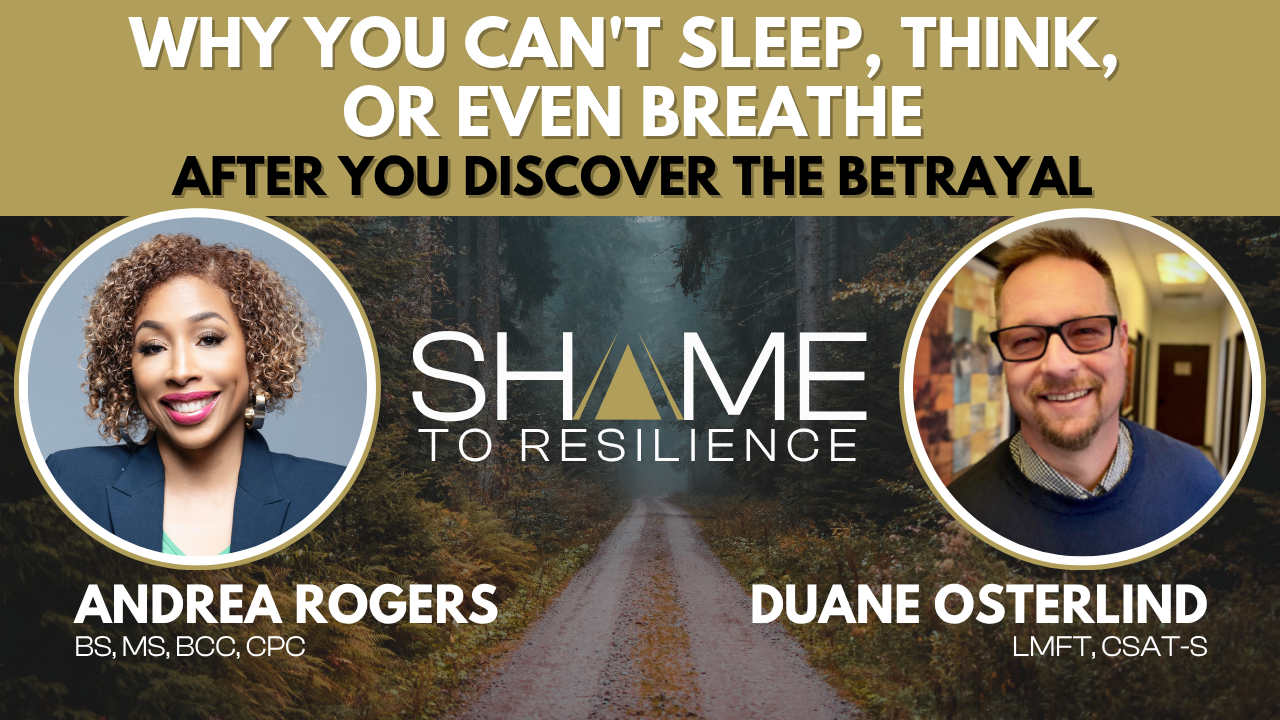
We call it cheating. Andrea Rogers calls it what it actually is: somebody threw a grenade into her life and blew it up — and she's still standing. In this conversation, she names the invisible symptoms most people never see, why grief brings casseroles but betrayal brings silence, and the hardest truth the person who caused the harm has to hold: you are the weapon. There is hope here. It's hard work — but we can heal.
Somebody threw a grenade into her life and blew it up. And she's still standing.

That's how Andrea Rogers describes what happened to her. And here's the thing — that's not dramatic language. That's the most accurate description of intimate partner betrayal I've heard in a long time. Because the word we usually reach for is cheating, and cheating is a word our culture has made small. We joke about it. We shrug at it. He cheated, he said he's sorry, he wants to work on the relationship, so what's the problem?

The problem is that the word doesn't come close.

I sat down with Andrea — an APSATS-certified partner coach, a brainspotting practitioner, the founder of Intimate Partner Betrayal Awareness Day, and someone who lived this herself starting with her own discovery day in 2014 — to talk about what actually happens to a person when their partner has been living a double life. If you're the one who caused the harm and you want to repair it, this is the most important thing you'll read this week. Not because it'll make you feel better. It won't. But because you can't repair damage you can't see.

"It's Not Just Cheating"

Andrea's definition is broader than most people's, and it's broader for a reason. Intimate partner betrayal isn't only physical affairs. It's a violation of the safety and the agreements of the relationship — which includes financial deception, spiritual manipulation, ongoing secret behavior, and the whole architecture of lies built to protect it.

And she's specific about the intimate partner part. You can experience betrayal trauma in a lot of settings — a family, a church, a workplace. But when it's the person you sleep next to, the person you had children with, the person whose read on reality you've been borrowing for years — there's a depth to that most people don't understand.

It is a total obliteration of someone's world, themselves, the life as they knew it.  — Andrea Rogers

Obliteration. Not disappointment. Not hurt feelings. Obliteration.

Discovery Day: Waking Up in a World That Isn't Real

Andrea describes it this way: she thought she was living her dream life, and she woke up in her worst nightmare. She didn't sleep. She left the house and went to a hotel and just sat in the shock of it. She didn't know who to call.

Then a friend asked the question that made it worse and truer at the same time: Are there more people than what he told you? That's when the real trauma hit. Because the question underneath that question is the one that takes the floor out from under you — if you lied about this, what else have you lied about?

She had two images for it, and I keep thinking about both. The first: it's like waking up and finding out you're adopted. Same people, same house, same name — and a whole different biology underneath it. The second: it's like walking down the street and falling into a deep hole, and looking around and realizing there are other people down here, but nobody up on the street knows the hole exists.

This is what I mean when I talk about shattered reality. It's not a metaphor. Your partner's brain is now doing something it did not ask to do: re-sorting every memory it has through the lens of what it now knows. Every trip you said you took. Every night you said you worked late. All of it is being reprocessed. If you want the neuroscience of why that happens and why it's involuntary, I break it down in the neurobiology section of the Betrayal Trauma Ultimate Guide.

The Symptoms Nobody Can See

Here's the part I really wanted Andrea to name out loud, because betrayal trauma is one of the most invisible injuries there is. She listed them:

  • Sleeplessness

  • Brain fog — she loved to read, and afterward her brain simply couldn't process the words on a page

  • Anxiety and panic

  • GI issues, migraines, high blood pressure, autoimmune flares

  • Neurological symptoms — she couldn't find words she'd known her whole life

  • A trip to the grocery store suddenly feeling dangerous, because who's going to see you, who knows, who's going to walk up and start talking

She compared it to multiple sclerosis — it's called multiple because the symptoms are everywhere and they don't look related until you know what you're looking at. That's betrayal trauma. It ripples out into everything. And her line for what it physically felt like has stayed with me: like somebody took my skin off. The wind hurt. Breathing was hard. An elephant sat on her chest.

Now, none of that is visible from the outside. So the person who caused the harm looks over and sees a partner who seems okay-ish today, and thinks — I apologized. I'm doing the work. Why is this still happening? And that gap is where so much damage gets done after the damage. If you want the clinical map of these symptoms and how closely they track PTSD, that's laid out in the PTSD symptom clusters section of the guide.

Why Betrayal Isolates When Grief Connects

Andrea's sister died in the middle of all of this, and the contrast she drew is one of the most useful things in the entire conversation.

When someone you love dies, there's a collective experience around it. You can post about it. People bring food. They send flowers. There's a funeral. Grief gets a container.

Betrayal is the exact opposite. It pushes you into secrecy. And here's the cruelest part of it — her partner had been living a double life, and now she was living one. Smiling at work. Getting the kids to school. Dying on the inside. She started to feel deceptive herself, just trying to maintain a reality that didn't drag everyone she knew into the wreckage.

Read that again if you're the one who caused the harm. The secrecy you built didn't end when you got caught. She inherited it.

You Are the Weapon

This is the section I'd ask you to sit with the longest.

Andrea explains it to betraying partners like this. Imagine you left a gun out. Your partner says, put that away, I don't want that here. And you say, it's fine, it's safe — but unbeknownst to you, it's loaded. And you shoot your partner.

Now, afterward, you can take the gun apart. You can show them the empty chamber. You can explain, in detail, that it isn't loaded anymore.

It doesn't matter. The mere presence of the weapon is threatening.

You as the betraying partner are the weapon. You are the gun. You are the thing that caused the harm.  — Andrea Rogers

She gave a small example that will land hard for a lot of men. Her former partner came home, walked into the kitchen while she was cooking, and said, can you talk for a minute? — because he wanted to tell her something away from the kids. Completely ordinary sentence. And it detonated. Because in her nervous system, we need to talk means another disclosure is coming. Another truth she's about to survive.

He couldn't fathom that something so small produced something so big.

That's the work. Not defending the size of your partner's reaction. Understanding that their brain cannot separate the threat from the person — and that person is you. Andrea says the reframe is what changes how you move: if you knew somebody had been shot, you'd take extraordinary care about ever bringing a gun near them again. You'd holster it. You'd leave it in the car. You'd announce it. You wouldn't argue about whether it was loaded.

And she names the hardest part honestly: it's not personal. Your partner doesn't hate you. They're in fear of the thing that was done. Your job is to hold that without getting defensive about it.

Why You Can't Do That Until You Deal With Your Shame

Here's where my work and Andrea's work meet.

You have to hold two things at the same time: I am the weapon, and I am a person who can change. Holding both is enormously hard, and most men can't do it — not because they don't care, but because the first one floods them with shame, and shame doesn't sit still. It moves. It becomes defensiveness. Or withdrawal. Or self-attack that somehow ends up requiring your partner to comfort you. Or avoidance — busyness, projects, sobriety-as-performance.

Every one of those is a shame response, and every one of them abandons your partner at the exact moment they need you present. That's what the Compass of Shame maps — the four directions shame pushes us when we can't tolerate it.

Andrea named the mechanism underneath the behavior too, and it's exactly right: the acting out was the medicine. It's what lightened the load. So when the acting out stops, the pain doesn't — now you've got your own pain plus the pain you caused. That's the heavy lifting. She said she's never met a betraying partner who knew, going in, how much damage this would do. Most of them are shocked by it themselves.

That's not an excuse. It's a starting point. You can't regulate what you can't name, and you can't be there for your partner if you can't tolerate being the person who hurt them. But you can learn to do that. I watch men do it. It is hard work, and it is possible.

How a Partner Takes Their Power Back

If you're the betrayed partner reading this — and I know you are, because you're often the one who finds this page first — Andrea's path back is worth naming.

  • Community. Her support group became the only place she could be understood without a long explanation. She's blunt about it: you can't heal in isolation.

  • Language. The first time she heard the word gaslighting, and the first time she saw the power and control wheel, something clicked. Her words: I smelled gas, but everywhere I looked I couldn't find the leak — so maybe I'm the problem. Language told her she wasn't the problem. She wasn't stupid. Her body had been talking to her the whole time and she'd been listening.

  • Advocating for herself, even against the professionals. She wanted a full disclosure. She wanted verification. She was told she didn't need one, that she was trying to bulldoze the process. She fired them. She got her truth. (She'll tell you now that the disclosure she got wasn't therapeutic and she doesn't recommend that route — but the refusal to hand her life to people who don't walk in her shoes is what turned the corner.)

She knew she was healing when she stopped being afraid to speak up. When the people-pleaser was gone. When she could tell her story and not feel like she should be ashamed of it. And this line — every time I chose myself, I felt more empowered.

You're the One With the Pen

Andrea's frame for all of it is the one that stays with me.

As a betrayed partner, you're a victim of someone else's choices. You didn't ask for it. You didn't cause it. And — not but, and — nobody can do your healing for you. It's like a car accident where someone else was driving. They can't go to your physical therapy. You still have to do the rehab. It's unfair and it's yours.

The rest of the story that comes after — you are the one with the pen.  — Andrea Rogers

Maybe you're left with a limp. Maybe you get a bionic knee. Either way, you're writing what comes next. That's not a consolation prize. That's the only real power in the room.

Intimate Partner Betrayal Awareness Day — August 4

Andrea founded Intimate Partner Betrayal Awareness Day because we have days for domestic violence, for autism, for cancer — and nothing for this. People carry PTSD symptoms out of these relationships. We understand it when someone comes back from a war. This is a war too. She said: somebody threw a grenade into my life and blew it up, and I'm still standing. Where's my medal?

It's August 4. The theme is Embers of Light — because after the flames die down, the embers are the life that's still there, and you can fan an ember back into a flame. That's also the title of the picture book she wrote for betrayed partners, An Ember of Light.

There's a moment of silence at 8:04 a.m. and 8:04 p.m. Central, live conversations with partners and professionals all day, and — because August 4 is also National Chocolate Chip Cookie Day — a partnership with Tiff's Treats. Last year, something happened that Andrea didn't plan for: betraying partners found out about the day and sent flowers, took their partners to dinner, wrote amends letters, thanked their partner for still giving them a chance to repair.

She's clear that it isn't a celebration. It's an honoring. Everything can still look burned. The ashes can be all you can see. The embers are still under there.

Details, the book, and the schedule: ipbawareness.org

If You're the One Who Caused the Harm, Start Here

Three things you can actually do this week:

  • Stop measuring her reaction against your intent. "I didn't mean it that way" is true and it is irrelevant. The weapon doesn't care about intent.

  • Watch your own body when she's in pain. The heat in your chest, the urge to explain, the urge to leave the room — that's shame arriving. Name it silently. Stay in the chair. That's the whole skill, and it's harder than it sounds.

  • Do your own work in your own room. Your partner is not your therapist, your accountability partner, or your comfort. Get support that's yours.

There is the possibility of healing here. I've watched it happen. It's hard work — but we can make these changes.

FREE DOWNLOAD — THE SHAME COMPASS

Shame is the weight sitting underneath the betrayal — for the partner carrying the wound and for the person who caused it. Our free Shame Compass e-book breaks down the four directions shame pushes us and how to start moving through it instead of around it. Get it free at shametoresilience.com/shamecompass.

RELATED READING

READY FOR STRUCTURED SUPPORT?

If you're the one who caused the harm and you're ready to do this in a room with other men doing the same thing — our next workshop is at workshop.shametoresilience.com. When you're ready. Not before.

Read More

3 Things to Never Say to Your Betrayed Partner (and What to Say Instead)

After betrayal, the words you choose in the next 30 seconds either calm your partner's nervous system or send it spiraling. A therapist breaks down the three phrases that quietly re-injure your partner — and exactly what to say instead.
When your partner gets triggered after infidelity, the words you choose in the next thirty seconds will do one of two things: calm their nervous system, or send it into a spiral. There's no neutral. And there's actual neuroscience behind why.

If you're the partner who caused the harm and you're genuinely trying to rebuild trust, this is one of the most practical shifts you can make. Most of the phrases that make things worse aren't cruel — they're human. They come out when you're flooded, defensive, or desperate for the pain to stop. But to your partner's traumatized brain, they land like a second injury. Here are the three I hear most often, what they do inside your partner's brain, and exactly what to say instead.

Phrase #1: “I already apologized for that.”

Don’t say:  “I already apologized for that.”

Here's what's happening in your partner's brain. Betrayal trauma impairs the hippocampus — the brain's memory center — so traumatic memories don't get filed away properly. They stay fragmented and emotionally charged. So when your partner brings it up again, they're not choosing to punish you. Their brain is literally re-experiencing the trauma as if it's happening right now.

And when you say “I already apologized,” their brain hears something specific: your pain has an expiration date. Now they feel both the original wound and the abandonment of being told they should be over it. You haven't closed the conversation — you've doubled the injury.

Say instead:  “I hear that you're hurting. Tell me what's coming up for you right now.”

That validates their pain and shows you're willing to sit with it instead of rushing past it.

Phrase #2: “You're never going to forgive me, are you?”

Don’t say:  “You're never going to forgive me, are you?”

This one sounds vulnerable, which is exactly why it's so easy to miss. But it actually makes your partner responsible for managing your shame. Their amygdala — the brain's threat-detection center — is already in overdrive, flooding their system with stress hormones. They're in survival mode. And now you're asking them to pause their own crisis to reassure you about the pain you caused them.

In that moment, the conversation quietly stops being about their healing and becomes about your comfort. That's the shame trap, and it abandons your partner at the exact moment they need you present.

Say instead:  “I know I broke your trust deeply. I'm committed to earning it back through my actions. Take all the time you need.”

This removes the pressure and puts the responsibility where it belongs: on you, to rebuild trust through consistent, trustworthy behavior over time.

Phrase #3: “I told you where I was. What more do you want from me?”

Don’t say:  “I told you where I was. What more do you want from me?”

When you say this, your partner's brain registers one thing: I'm not safe. Their prefrontal cortex — the part responsible for logic and emotional regulation — is already compromised by trauma. It's essentially offline. So they can't just reason their way out of hypervigilance. The checking, the questions, the need to verify — it isn't a choice. It's their nervous system trying to protect them from another devastating blow.

Say instead:  “I know my actions destroyed your sense of safety. Answering your questions is the least I can do. Ask me anything.”

Instead of treating their need for information as an attack, you treat it as a reasonable response to a real injury — and you become part of the answer rather than another source of threat.

The Pattern Underneath All Three

Once you see it, you can't unsee it. The phrases that make things worse are all about you — your feelings, your frustration, your shame, your need for reassurance. The phrases that help are all about them — their experience, their pain, their needs, their timeline.

When you shift from defending yourself to validating your partner, their nervous system actually begins to regulate. You stop being a source of threat and start becoming a source of safety. That's not a personality you're born with — it's a skill, and it's exactly what shame resilience makes possible: the ability to feel your own shame in the moment and choose empathy anyway, instead of collapsing into defense.

If this resonated, the next step is understanding why your partner's brain reacts the way it does in the first place — and what consistently rebuilds safety over time. Start with the neurobiology of betrayal trauma, then read what to do when your partner is triggered. And if you want to build this skill with structure and a group of men doing the same work, that's exactly what the Shame to Resilience workshop is for.

Duane Osterlind, LMFT, CSAT-S

About the Author

Duane Osterlind, LMFT, CSAT-S

Licensed Marriage & Family Therapist  ·  Certified Sex Addiction Therapist Supervisor  ·  Founder & Clinical Director, Novus Mindful Life Institute  ·  Licensed in CA, FL, TX, VA & ID

Duane Osterlind is a therapist with over 15 years of experience helping men recover from infidelity, sex addiction, and betrayal trauma. He is the founder and clinical director of Novus Mindful Life Institute, where he leads a clinical team specializing in sex addiction and betrayal recovery. He is also the co-founder of Shame to Resilience, host of The Addicted Mind Podcast, and former co-founder of Helping Couples Heal and the Helping Couples Heal podcast. His clinical work centers on the Compass of Shame framework and building shame resilience so that empathy — the essential ingredient for relationship healing — becomes possible.

Read More

The Truth About Polygraphs in Betrayal Recovery (What They Can and Can’t Do)

A polygraph isn’t a lie detector — it’s a truth verification tool. A therapist and a 19-year examiner explain what a disclosure polygraph can and can’t do, and how it helps rebuild a foundation of trust after betrayal.
The moment most people hear the word polygraph, they have a reaction. If you're the betrayed partner, something in you says, good — I want proof. If you're the person who caused the betrayal, you're probably terrified. Both of those reactions make complete sense.

I wanted to get past the reaction and into the reality, so I sat down with Ryan Angulo, a polygraph examiner out of Southern California with almost 19 years of experience and somewhere north of 25,000 exams administered. He does between 150 and 200 disclosure polygraphs every single year. He knows this world from the inside. What follows is what I've learned working alongside him — and what I want you to understand before you ever walk into that room.

A Polygraph Isn't a Lie Detector. It's a Truth Verification Tool.

This sounds like a small distinction. It changes everything.

A polygraph doesn't detect lies. It verifies the truth. That means it isn't looking to catch you in a crime — it's structured so that an honest person can clearly and confidently say yes, that's true. When someone is uncertain, vague, minimizing, or giving a partial answer, the test can't settle. So a good examiner builds the exam around questions that are immediately recognizable, where the answer is one hundred percent clear in your own mind.

That's why the quality of the examiner matters so much. This is a very particular kind of polygraph. It has to be handled with care, expertise, and an understanding of both the person who caused the harm and the person who was harmed.

What a Disclosure Polygraph Is Actually For

In recovery, the disclosure is the moment all the facts get put on the table — as honestly and completely as they can be. The polygraph isn't separate from that. It's used to verify the disclosure document: to confirm that what's written there is accurate, that nothing is being withheld, and that the behaviors have actually stopped.

Ryan uses an image I think about often. After betrayal, the partner has been in a free fall — like an elevator dropping with no idea when it will hit bottom. The goal of a disclosure polygraph isn't to answer every question they've ever had. It's to put their feet on solid ground. The doors open, they can finally see clearly, and now they have enough information to make a decision: stay on the elevator and ride back up, step off and walk around, or leave. It gives them a foundation. It does not promise them everything.

If you want to understand why the betrayed brain craves that footing so badly, it helps to understand the neuroscience of betrayal trauma — why the nervous system stays on high alert until it has something reliable to stand on.

What the Process Actually Looks Like

Ryan asks for the disclosure document at least 48 hours in advance. He strips it down to the bottom-line behaviors — the who, what, when, and where — because that's what a polygraph can verify.

Then the person comes in, and it starts as a conversation, not an interrogation. And here's the part I most want you to hear if you're the one being tested: this is fundamentally different from a criminal or pre-employment exam. In those settings, the examiner doesn't care whether you pass or fail. In this kind of polygraph, nothing good comes from a failed test — not for you, not for your partner, not for the therapy. So Ryan's goal isn't to trap you. His goal is to help you be honest, so that you're enabled to pass.

This is exactly the work of the disclosure process itself — full truth, told once, so the rebuilding can begin.

What a Polygraph Can't Do

A lot of pain comes from expecting the polygraph to be something it isn't — a magic eight ball that answers any question you type into it. Here are the most common misconceptions Ryan sees from betrayed partners:

  • The partner can't be in the room. Only the examiner and the person being tested.

  • You can't load it up with 15 questions. More questions don't make the test stronger. They make it less reliable.

  • It can't test thoughts, feelings, or intentions. A polygraph measures responses to concrete actions, not what was in someone's heart or mind.

  • More is not better. A polygraph is at its best when it's focused on a single, clear issue.

When too many topics get crammed in, the test wanders and stops giving you the one thing you actually need: a trustworthy foundation. If someone fails or comes up inconclusive on even one question, the whole test is read as a failure — and you learn nothing reliable about the others. Focus is what makes the result usable.

The One Question That Matters Most

If you could ask a disclosure polygraph just one thing, this is it:

"Have you intentionally withheld any information from this disclosure document?"

Withheld is the key word. It covers everything less than the full truth — omitting, minimizing, exaggerating, or altering something you know and aren't saying. Built that way, the entire test orbits one clear issue: at this moment, with everything we've talked about, are you still holding something back? In my experience and Ryan's, that single, focused question is the most powerful way to run a disclosure polygraph.

"But What If I'm Just Nervous?"

This is the fear I hear most from honest people: I'm telling the truth, but what if my nerves make me fail?

Here's the reassurance. Nervousness is part of every polygraph — there's always something real at stake. A perfectly flat, reaction-free chart isn't what passing looks like; it's actually a red flag. An honest person responds. The questions are all built around the same topic, so a truthful person develops a consistent pattern of response. Nerves don't fail you. A problem with a specific question is something different, and a skilled examiner can tell them apart.

It's a Tool — Not a Verdict

A polygraph is not perfect, and no honest examiner will tell you it is. No diagnostic test is. But "it's not admissible in court" and "it's only 50/50" are myths. Modern exams used within best standards of practice are highly reliable, and they're used all the time in serious settings before charges are ever filed. The real weakness in the field isn't accuracy — it's the lack of standardization, which is exactly why choosing an experienced, ethical examiner matters so much. (For the research and professional standards behind the method, the American Polygraph Association is the authoritative source.)

The healthiest way to hold it is as one tool among many. Ryan uses a simple picture: when you plant a young tree, you stake it on both sides — not forever, but until it's strong enough to stand on its own through wind and weather. Forced accountability works the same way. It holds trust upright while the relationship is still too fragile to stand alone. The polygraph belongs alongside therapy, twelve-step work, weekly check-ins, and behavior that finally matches words. If everything else is telling you the truth, the test adds to it. And if everything else says someone is still lying, don't trust the one result that disagrees with all the rest.

This is the same principle behind why honesty alone isn't enough to rebuild safety — truth and consistent, predictable action have to work together.

For the Person Who Caused the Harm: This Can Be an Easy Win

If you're being honest, I want to reframe this for you. I won't pretend it isn't scary — it is. But if you've put it all on the table and you're doing your work, this is an easy win. You get to hand your partner something concrete that says, I'm not hiding anymore.

What I see again and again is that the hardest part is one last secret — the single detail someone is convinced will bring everything down if they say it out loud. So they hold it. And the polygraph becomes the nudge that finally gets them from ninety percent honest to one hundred percent. That last piece comes out, and something shifts.

Ryan told me about a client he'd tested months earlier who had failed over one withheld detail — then came back, told the truth, and passed. Six months later the same man walked in looking healthy and steady. His life was still in chaos; he didn't know if his marriage would survive. But he said it was the first time in his life he'd ever been free of his secrets — the first time he'd walked an honest, integrity-filled path. "Worst case," he told Ryan, "I know I'm going to be a better human being on the other side of this."

That's the path from shame to resilience. You can't build anything real on a hidden foundation. But the truth — all the way out, no matter how hard — is the ground everything good gets built on. For the partner, the journey is just beginning, and that pain is real and worthy of patience. For you, putting it all out there is where your deep healing finally starts.

Frequently Asked Questions About Polygraphs in Betrayal Recovery

How much does a polygraph cost?

In Southern California, a therapeutic disclosure polygraph usually runs between $500 and $1,000, depending on the examiner and location. It's a real investment — but many couples find the clarity and accountability it brings to recovery well worth it.

What does an inconclusive result mean?

Inconclusive means the data wasn't clear enough to call truthful or deceptive — it is not a verdict of guilt. Anxiety, a medical condition, or other factors can muddy the readings without meaning someone lied. A good examiner uses the post-test conversation to understand what happened, so try not to jump to conclusions about an inconclusive result.

Can someone actually cheat or beat the test?

It's far harder than the internet makes it sound. The instrument records real physiological responses that can't simply be tricked — what someone might attempt is to manipulate the data to fool the examiner, not the machine. That's exactly why the examiner's skill matters. Vet yours: ask about their training and experience with betrayal trauma. A confident, ethical examiner welcomes those questions.

How often do polygraphs need to be repeated?

It depends on the plan you build with your therapist. Often "maintenance" exams start every three to six months, then move to an annual check-in. As the person in recovery keeps showing consistent honesty and follow-through, the need for testing naturally fades — the goal is always to need it less over time, not more.

Should you do the polygraph before or after disclosure?

Both can work, and it's a clinical call you make with your therapist. A pre-disclosure exam can encourage a more complete disclosure; a post-disclosure exam verifies what was shared. From the polygraph side there's no technical difference — what matters is deciding the timing before you schedule.

Is the polygraph accurate?

No test is perfect, but a properly run, single-issue exam lands in the low-to-mid 90s for accuracy. That's why focus matters so much — the tighter the question, the more reliable the result. Used correctly and alongside therapy and real behavior change, it's a strong tool, not a magic answer.

Thinking about a polygraph as part of your recovery — or just have questions? We created a free Polygraph FAQ Guide with Ryan Angulo that answers the 18 most common questions about polygraphs in betrayal recovery: accuracy, cost, timing, inconclusive results, whether someone can "beat" the test, and more. Download the free Polygraph FAQ Guide here.

Duane Osterlind, LMFT, CSAT-S

About the Author

Duane Osterlind, LMFT, CSAT-S

Licensed Marriage & Family Therapist  ·  Certified Sex Addiction Therapist Supervisor  ·  Founder & Clinical Director, Novus Mindful Life Institute  ·  Licensed in CA, FL, TX, VA & ID

Duane Osterlind is a therapist with over 15 years of experience helping men recover from infidelity, sex addiction, and betrayal trauma. He is the founder and clinical director of Novus Mindful Life Institute, where he leads a clinical team specializing in sex addiction and betrayal recovery. He is also the co-founder of Shame to Resilience, host of The Addicted Mind Podcast, and former co-founder of Helping Couples Heal and the Helping Couples Heal podcast. His clinical work centers on the Compass of Shame framework and building shame resilience so that empathy — the essential ingredient for relationship healing — becomes possible.

Read More

Why Some People Keep Secrets: Dismissive Avoidant Attachment and the Origins of Infidelity

You replay the dinners and the vacations and wonder how he could sit there. Dr. Stan Tatkin on the attachment pattern underneath secret keeping — and why repair has to go deeper than a promise to be honest.
By Duane Osterlind, LMFT, CSAT-S

If you're the partner who kept secrets — the one who lived a double life, who held an entire hidden world apart from your relationship — you may have spent a lot of time asking yourself: Why am I like this? Why was it so easy to compartmentalize? Why didn't I just tell the truth?

In Part 3 of my conversation with Dr. Stan Tatkin, he traced the capacity for secret keeping back to its origins. And the answer might be the first time someone has explained your internal world back to you in a way that actually makes sense. This doesn't excuse the behavior — not even close. But it does help explain what you're working with, so you can actually change it. Because as Stan would put it: you can't change what you can't see.

The Attachment Style Underneath Secret Keeping

Stan identified a specific attachment pattern that shows up in many of the people who develop the capacity for sustained deception in their relationships: dismissive avoidant attachment. And he traced it all the way back to infancy.

Here's how it develops. A child reaches for connection — attention, comfort, attunement — and that reaching isn't met. Not because the parents are abusive, but because they're emotionally unavailable. Distant. Preoccupied. Maybe well-meaning, but not actually present in the way an infant's nervous system needs. The child learns something. They learn that reaching out doesn't work. So they stop reaching. They go underground.

Stan was clear about what “going underground” means at a developmental level. The child learns to auto-regulate. To keep things internal. To not bring their emotional life into relationship with anyone, because relationship has been proven — to their developing nervous system — to be an unreliable source of co-regulation.

It's not because they're choosing to deceive. It's because it's the only adaptation they've ever known.

— Dr. Stan Tatkin (paraphrased)

How This Pattern Shows Up in Adult Relationships

Fast forward thirty or forty years. The infant who learned to auto-regulate is now an adult in a committed relationship. And the pattern is still running. They struggle to bring their internal world into the relationship. They handle things alone. They don't tell their partner when they're struggling. They develop a robust internal life that operates separately from the shared life of the relationship.

And then — if other risk factors are present — that internal life can include things their partner doesn't know about. Affairs. Pornography use. Financial deception. Sexual acting out. The capacity for compartmentalization that protected them as a child becomes the architecture of a secret life as an adult. This isn't a moral failing. It's a developmental adaptation that was once useful and is now causing devastating harm. Both of those things can be true at the same time.

Why This Pattern Is Harder to Change

Here's what Stan said that I think is the most clinically important point in this section: people with dismissive avoidant attachment have a harder prognosis than people with other patterns — not because they're more damaged, but because they don't know what they've been missing.

Think about that for a second. If you grew up reaching for connection and getting hurt, you at least know connection exists — you're just afraid of it. But if you grew up never reaching at all, never expecting connection, never knowing what attuned co-regulation feels like — you don't know what's been absent from your life. You think the way you experience relationships is just how relationships work. That's the part that makes the work so hard. You can't fix what you don't recognize as broken.

What Can Actually Change This Pattern

Stan said something else in this part of our conversation that I keep coming back to: “It's over. As you thought this was. It's gotta be a complete rebuild.” The relationship the person had before discovery was built on the dismissive avoidant pattern. They could keep secrets because nothing in the system required them not to. Going forward, that's not an option anymore. The entire architecture has to be different.

That means the person who kept the secrets has to do something they've never done before in their life: bring their internal world into relationship. Consistently. Without curating it. Without holding back the parts that feel risky to share. Without going underground when things get hard.

This is the work. And it cannot be done alone. As Stan emphasized throughout our conversation, the only way to rewire dismissive avoidant attachment is through repeated experiences of safe, attuned, co-regulated connection — with a therapist, with safe friends, with a partner who is willing to do the work alongside them. You can't think your way out of an attachment pattern. You have to experience your way out of it.

What This Means for the Work Ahead

If you're the person who kept the secrets and you recognize yourself in this description, I want you to hold two things at once. Yes, this is an explanation of how you got here. No, it does not excuse the harm you caused. Both things have to stay true at the same time.

The good news — if there is good news here — is that attachment patterns can change. Not easily. Not quickly. But they can. And the change happens through exactly the thing your nervous system has been avoiding your whole life: showing up in relationship, telling the truth, staying connected when shame wants you to retreat.

This is the heart of what we work on in the Shame to Resilience workshop. Building the capacity to stay in relationship when every instinct says to go underground. Learning to bring your internal world to the surface, even when it feels dangerous.

In Part 4 — the final part of my conversation with Stan — we get into shame itself. The difference between guilt and shame, why leading with shame actually makes things worse for your partner, and what to do instead. That's where the practical tools are.

Watch the full series

Part 1: What Betrayal Does to the Brain

Part 2: Boundaries as Good Faith Effort

Part 3: Attachment and the Origins of Secret Keeping (this post)

Part 4: Shame, Guilt, and the Path Forward

About Dr. Stan Tatkin: Developer of PACT (Psychobiological Approach to Couples Therapy) and author of Wired for Love and In Each Other's Care. Learn more at thepactinstitute.com

Duane Osterlind, LMFT, CSAT-S

About the Author

Duane Osterlind, LMFT, CSAT-S

Licensed Marriage & Family Therapist  ·  Certified Sex Addiction Therapist Supervisor  ·  Founder & Clinical Director, Novus Mindful Life Institute  ·  Licensed in CA, FL, TX, VA & ID

Duane Osterlind is a therapist with over 15 years of experience helping men recover from infidelity, sex addiction, and betrayal trauma. He is the founder and clinical director of Novus Mindful Life Institute, where he leads a clinical team specializing in sex addiction and betrayal recovery. He is also the co-founder of Shame to Resilience, host of The Addicted Mind Podcast, and former co-founder of Helping Couples Heal and the Helping Couples Heal podcast. His clinical work centers on the Compass of Shame framework and building shame resilience so that empathy — the essential ingredient for relationship healing — becomes possible.

Read More

What Betrayal Does to the Brain: Dr. Stan Tatkin Explains Why You Can't Stop Asking Questions

PACT developer Dr. Stan Tatkin explains why discovery of betrayal hijacks the brain, why obsessive questioning is biological, and why partners can’t “just move on.”
If you’ve discovered your partner’s betrayal and you can’t stop asking questions — if you’re up at 3 a.m. replaying every holiday, every conversation, every moment you thought was real — there is nothing wrong with you. Your brain is doing exactly what it’s designed to do.

I recently sat down with Dr. Stan Tatkin, the developer of PACT (a psychobiological approach to couples therapy) and the author of Wired for Love and In Each Other’s Care. Having completed his Level 1 training myself, I can tell you it changed how I do couples work. And what he shared about what’s happening in the brain after betrayal is discovered is some of the clearest, most validating information I’ve heard on this topic.

Let me walk you through it.

First, What Actually Counts as Betrayal?

Stan made an important distinction at the start of our conversation. People use the word “betrayal” for all sorts of things — your partner buying something they said they wouldn’t, telling someone a secret they had no right to share. Those things hurt, but they don’t produce the kind of neurological injury we’re talking about here.

The kind of betrayal that creates trauma is something specific. As Stan explained, it’s the discovery of vital information that you had a right to know but were deprived of — information that, once discovered, changes everything: who you thought you were, who your partner is, what’s true, what’s not true, and your identity within the relationship.

The major violation is the lack of free flow of information — omission, lying by omission on something big. That’s what does the damage. — Dr. Stan Tatkin

This matters because it reframes the wound. The sexual element of an affair isn’t pleasant, but it’s not actually what produces the trauma response. The deception is. The systematic withholding of information that the betrayed partner had every right to know is what hijacks the nervous system.

What Happens in the Brain at Discovery

When that vital information lands, the discovery partner experiences a measurable set of symptoms that mirror PTSD. Stan listed them clearly: mood instability, sleep problems, flashbacks, paranoia, thoughts that won’t go away, questions that have to be asked, and the disorienting feeling of “sleeping with the enemy” — of no longer being able to know the person they thought they knew.

This isn’t a judgment. It isn’t a personality flaw. As Stan put it, this happens by proof — it just is a fact.

And here’s the part that I think is the most important thing he said. The brain doesn’t ask your permission to do this.

My brain will automatically re-sort this new data, and it will be busy for quite some time — especially if it was back in the beginning. — Dr. Stan Tatkin

The new information intrudes on every memory the betrayed partner has of the relationship. It has to be re-sorted. Every birthday. Every anniversary. Every conversation. Every “I love you.” The brain runs this process automatically, without conscious choice, because it has to reconstruct who you are, who your partner is, and what your shared history actually means.

Stan was direct about this: people who judge the discovery partner for being “still upset” or “still perseverating” months after discovery are missing the science. The mind can’t do anything else. In the first year especially, this is what every brain does when it encounters this level of identity-shattering information.

Why You Can’t Stop the Questions

In our conversation, I shared a way I often think about this: to know our environment is to keep ourselves safe. If we can’t know our environment, we can’t predict our environment. And if we can’t predict our environment, our brain can’t get to a state of safety — because it doesn’t know what to do.

Stan agreed. He pointed out that humans aren’t actually safe most of the time — we just have a denial system that protects us from thinking about it constantly. After betrayal, that denial system collapses. And the brain goes into overdrive trying to rebuild a coherent picture of reality.

That’s why the questions don’t stop. The brain isn’t trying to torture anyone. It’s trying to gather enough data to reorganize the file system. To answer: Who is this person, really? What was true? What was a lie? Can I predict what they’ll do next? Until those questions have answers — honest, complete, consistent answers — the brain will keep asking.

What This Means for Your Healing

If you’re the betrayed partner reading this, I want you to hear what Stan said: you’re not crazy. You don’t have a personality disorder. You’re not being dramatic. Your nervous system is responding to a real injury in the way nervous systems are designed to respond.

And if you’re the person who caused the betrayal, this is the part that matters: you cannot talk your partner out of this process. You cannot reason them out of it. You cannot apologize them out of it. Their brain has to do its job, and your job is to provide the consistent, honest, predictable behavior that gives their brain enough data to eventually let down its guard.

I break down the specific neuroscience of this — what happens in the amygdala, hippocampus, and prefrontal cortex — in our complete guide to the neurobiology of betrayal trauma. And if you want to understand the symptoms your partner is experiencing through a clinical lens, I cover that in Why Betrayal Trauma Feels Like PTSD.

In Part 2 of my conversation with Stan, we get into something that I think is even harder to hear but just as important: boundaries. Not as punishment, but as the mechanism that actually gives relationships a chance to heal. I’ll link to that next.

Watch the full series:

Related reading:

About Dr. Stan Tatkin:

Dr. Stan Tatkin is the developer of PACT (Psychobiological Approach to Couples Therapy) and the author of Wired for Love and In Each Other’s Care. Learn more at thepactinstitute.com

Duane Osterlind, LMFT, CSAT-S

About the Author

Duane Osterlind, LMFT, CSAT-S

Licensed Marriage & Family Therapist  ·  Certified Sex Addiction Therapist Supervisor  ·  Founder & Clinical Director, Novus Mindful Life Institute  ·  Licensed in CA, FL, TX, VA & ID

Duane Osterlind is a therapist with over 15 years of experience helping men recover from infidelity, sex addiction, and betrayal trauma. He is the founder and clinical director of Novus Mindful Life Institute, where he leads a clinical team specializing in sex addiction and betrayal recovery. He is also the co-founder of Shame to Resilience, host of The Addicted Mind Podcast, and former co-founder of Helping Couples Heal and the Helping Couples Heal podcast. His clinical work centers on the Compass of Shame framework and building shame resilience so that empathy — the essential ingredient for relationship healing — becomes possible.

Read More

Why Transparency Isn’t Enough After Betrayal (And What’s Actually Missing)

You’re answering every question. You’re being completely transparent. You’re doing everything your therapist suggests — showing your phone, sharing your location, taking full responsibility. And your partner still doesn’t feel safe.

If you’re genuinely trying to repair the harm you caused, I want you to know something: the fact that your partner doesn’t feel safe yet doesn’t mean you’re failing. It might mean there’s a piece of the puzzle you haven’t been given yet.

Because here’s what I see in my work with couples:
You’re answering every question. You’re being completely transparent. You’re doing everything your therapist suggests — showing your phone, sharing your location, taking full responsibility. And your partner still doesn’t feel safe.

If you’re genuinely trying to repair the harm you caused, I want you to know something: the fact that your partner doesn’t feel safe yet doesn’t mean you’re failing. It might mean there’s a piece of the puzzle you haven’t been given yet.

Because here’s what I see in my work with couples: people give all the information and then wonder why their partner is still hypervigilant, still checking, still struggling to relax around them. “I told them everything,” they say. “Why isn’t that enough?”

The answer is one of the most important things I can teach you about rebuilding trust after betrayal:

Information alone doesn’t create safety. Information plus predictability creates safety.

Your Betrayal Broke Two Things, Not One

When I sit down with someone who has caused a betrayal, one of the first things I help them understand is that their partner’s brain isn’t just dealing with the loss of truth. It’s dealing with the loss of predictability.

Think about it this way: for months — maybe years — you were doing one thing while telling your partner another. You were saying “I’ll be home at six” while being somewhere else entirely. You were saying “nothing’s going on” while a whole hidden life was running in the background.

Your partner’s brain learned two things from that experience:

  • I cannot trust the information this person gives me.

  • I cannot predict this person’s behavior.

Both of those have to be rebuilt. And most people in recovery only focus on the first one.

Why Honesty Alone Doesn’t Calm a Traumatized Nervous System

When your partner asks “Where were you?” — yes, they need the honest answer. Absolutely. Complete honesty is non-negotiable, and your partner deserves nothing less.

But their traumatized brain is also asking a second question underneath that one: “Can I predict what this person is going to do? Can I trust that they’ll show up the way they say they will?”

This is where the neuroscience of betrayal trauma matters. The amygdala — the brain’s threat-detection center — doesn’t calm down just because it receives accurate information. It calms down when it can predict what’s coming next. When your partner’s brain can reliably anticipate your behavior and those predictions keep turning out to be correct, something shifts. The constant state of alert begins to ease. The hypervigilance begins to soften.

This is rooted in how the brain changes after betrayal — I break it down in the neurobiology of betrayal trauma.

But if your current behavior is still unpredictable — even if you’re being completely honest about the past — their nervous system can’t settle. It stays on guard, scanning for the next surprise. And that’s not a choice they’re making. That’s their brain doing exactly what it’s designed to do when it’s been blindsided before.

Where People Stumble: Focusing Only on the Past

Here’s the pattern I see over and over: someone does the hard work of disclosure. They take full responsibility. They answer their partner’s questions with honesty — no minimizing, no deflecting. And that matters deeply. I don’t want to minimize that for a second.

But then they think the rebuilding is primarily about the past. About the disclosure. About answering the same questions their partner asks over and over. And they get frustrated when the progress stalls.

The missing piece is almost always in the present.

If you say “I’ll be home by 5:30” and you walk in at 6:15 without a text, your partner’s amygdala fires. Even if you have a perfectly good reason. Even if it’s completely innocent. Their brain doesn’t care about the reason in that moment — it cares that, once again, it couldn’t predict what you were going to do.

And here’s the thing: that’s not your partner being controlling. That’s not them punishing you. That is a traumatized nervous system that learned the hard way that it cannot rely on your words matching your actions. You have to teach it something different.

The Formula: Honesty About the Past + Predictability in the Present

What actually builds safety after betrayal isn’t one thing. It’s two things working together:

  • Complete honesty about the past — full disclosure, no trickle truth, answering every question even when it’s hard.

  • Showing up exactly as you say you will in the present — over and over, day after day, until your partner’s brain has enough data to begin trusting the pattern.

Neither alone is enough. You can be completely honest about the past but unpredictable in the present — and your partner will stay on alert. You can be reliable in the present but still withholding pieces of the truth — and the foundation crumbles. Both have to be there.

This isn’t about manipulation or performance. This is about becoming someone whose words match their actions. That’s integrity. And integrity, practiced consistently, is what rebuilds trust.

A Practice You Can Start This Week

Here’s something concrete you can begin doing right now. It’s simple, but don’t let the simplicity fool you — this is one of the most powerful trust-building tools I teach.

At the beginning of each week, sit down with your partner and walk through your schedule together. Not just the big things — the ordinary things.

“Meeting Tuesday at 2, home by 5:30. Working late Wednesday, I’ll text at 6. Saturday morning I’m running errands — hardware store and groceries, back by noon.”

Then — and this is the part that matters most — you do exactly what you said.

If something changes, you communicate proactively. You don’t wait for your partner to wonder where you are. You text before the schedule shifts, not after.

When you do this — week after week, without fail — something remarkable happens. Your partner’s brain begins to learn a new pattern: “I can trust the information this person gives me AND I can predict their behavior. I don’t have to be on constant alert.”

That’s when the amygdala can finally begin to calm down. That’s when real healing becomes possible.

Why Shame Makes This Harder (And What to Do About It)

I know what some of you are thinking right now. “This feels like I’m reporting in. Like I’m on probation.”

I get it. And that feeling? That’s shame talking. Shame says, “If I have to account for my schedule, it means I’m a bad person being monitored.” But that’s not what this is.

What you’re actually doing is giving your partner’s brain the data it needs to feel safe. You’re not being controlled — you’re choosing to help rebuild something you broke. There’s a massive difference between compliance and commitment. Compliance says, “I have to do this.” Commitment says, “I’m choosing to do this because my partner’s healing matters to me.”

When shame floods your system and tells you this is degrading or unfair, that’s the moment to practice shame resilience — the ability to sit with that discomfort long enough to choose empathy over defense. Your partner isn’t asking for perfection. They’re asking for consistency. And consistency, over time, is what earns trust back.

And when shame floods your system and makes this hard, that's the shame-empathy gap.

What This Looks Like Over Time

In the early weeks, the schedule check-in might feel heavy. Your partner might still be anxious even when you follow through perfectly. That’s normal. Their brain needs a lot of positive data to override what it learned during the betrayal.

But over time — weeks, then months — the check-ins become lighter. Not because your partner stops caring, but because their nervous system has enough evidence to start relaxing its grip. They don’t need to check your phone as often. They don’t lie awake wondering where you are. Their brain has learned: “This person does what they say they’ll do. I can rest.”

That’s earned trust. And earned trust is the only kind that actually holds.

If you want the concrete version of this, start with three actions that build safety, not just words.

Both Matter. Neither Alone Is Enough.

Your partner needs the truth about what happened. And they need behavior that matches your words, every day, going forward.

If you’ve been doing the honesty work but wondering why your partner still can’t relax, this might be the missing piece. You’re not failing. You just have one more thing to rebuild.

If you want to understand the neuroscience behind this — why the amygdala stays on alert, why the hippocampus can’t organize the story, and what happens in the brain when trust begins to return — I break all of that down in my guide to the neurobiology of betrayal trauma.

And if you’re ready for structured support in building shame resilience — the skill that makes it possible to stay present with your partner instead of retreating into defensiveness. This is the work we do in the Shame to Resilience workshop.

Duane Osterlind, LMFT, CSAT-S

About the Author

Duane Osterlind, LMFT, CSAT-S

Licensed Marriage & Family Therapist  ·  Certified Sex Addiction Therapist Supervisor  ·  Founder & Clinical Director, Novus Mindful Life Institute  ·  Licensed in CA, FL, TX, VA & ID

Duane Osterlind is a therapist with over 15 years of experience helping men recover from infidelity, sex addiction, and betrayal trauma. He is the founder and clinical director of Novus Mindful Life Institute, where he leads a clinical team specializing in sex addiction and betrayal recovery. He is also the co-founder of Shame to Resilience, host of The Addicted Mind Podcast, and former co-founder of Helping Couples Heal and the Helping Couples Heal podcast. His clinical work centers on the Compass of Shame framework and building shame resilience so that empathy — the essential ingredient for relationship healing — becomes possible.

Read More

When Your Partner Is Triggered, and You Don't Know What To Do

Your partner gets triggered and you freeze. You don't know whether to speak, stay quiet, reach out, or just leave.

Most people in that moment do one of three things: they freeze, get defensive, or say something that makes it worse. And every time, it comes from the same place — you genuinely don't know what's happening in your partner's brain, so you don't know how to respond to it.

That's what I want to change.

When you understand what's actually happening neurologically when your partner gets triggered, responding with presence instead of defensiveness becomes possible. Not easy — but possible.
Your partner gets triggered, and the air leaves the room.

You’ve likely felt it a dozen times. You’re having a normal Tuesday evening, maybe even laughing together, and then—shift. A song plays, a name is mentioned, or you simply check your phone at the wrong moment. Suddenly, they are distant, angry, or devastated.

In that moment, you might freeze. You might get defensive. You might think, “We were doing so well, why are we back here?”

When your partner is triggered, their brain is in survival mode — that's the neurobiology of betrayal trauma at work.

I want you to know that this reaction—both theirs and yours—is deeply human. But if you want to move from a cycle of pain to a place of repair, you need to understand what is actually happening beneath the surface. You need to understand the neuroscience of a trigger.

When you can see a trigger not as an attack on you, but as a physiological safety response in them, everything changes. You stop defending your ego and start supporting their healing.

The Science of Safety (and Lack Thereof)

First, we have to clear the air about one major misconception. Your partner’s triggers are not a choice. They are not trying to punish you, manipulate you, or drag up the past to make you feel guilty.

When betrayal happens, it lands on the brain like a physical trauma.

Research into interpersonal neurobiology shows us that betrayal significantly impacts the amygdala—the part of the brain responsible for detecting threats. In a partner who has been betrayed, the amygdala becomes hyper-sensitized. It’s like a smoke detector that has been calibrated to go off not just when there is a fire, but when someone strikes a match three rooms away.

Simultaneously, the hippocampus—which processes memories—struggles to file the traumatic event into the "past." The trauma remains "live." So when a trigger hits, your partner isn't just remembering the pain; their brain is re-experiencing the danger in real-time.

This is why logic often fails in these moments. You cannot reason a nervous system out of a survival state. You can only communicate safety.

Myth-Busting: What Triggers Are Not

To truly support your partner, we have to unlearn some of the defensive narratives that shame tries to sell us.

Myth 1: They are doing this to control me.

Reality: They are experiencing a physiological flood of cortisol and adrenaline. Their body is screaming, “Danger!”

Myth 2: If they forgave me, they wouldn’t get triggered.

Reality: Forgiveness is a conscious choice; a trigger is an autonomic response. They can forgive you and still have a nervous system that remembers the injury.

Myth 3: I need to explain why they shouldn’t be upset.

Reality: Explaining is often heard as minimizing. When you try to talk them out of their feelings, their brain registers you as unsafe—someone who doesn't see the reality of their pain.

Identifying the Big Three Triggers

In my work with couples navigating recovery, I see three specific categories of triggers show up constantly. Recognizing them can help you stop being blindsided and start being prepared.

1. Uncertainty and Ambiguity

If you’ve been living a double life or hiding things, your partner’s brain has learned that "I don't know" equals "I'm in danger."

Vague answers are kryptonite to a betrayed partner. If they ask, "Who was on the phone?" and you say, "Nobody," or "Just a friend," their amygdala lights up. They need specifics to feel safe.

The Fix: Radical transparency. Don’t make them pull information out of you. Volunteer it. "That was my coworker, Steve, asking about the project deadline. Here, you can see the text."

2. Reminders of the Betrayal

These are the sensory cues—songs, locations, dates, phrases. They can feel random to you, but they are neural pathways associated with the trauma for them.

It’s easy to feel frustrated when a nice dinner is ruined because you drove past a specific hotel. But remember: their hippocampus is misfiring. They are reliving the discovery.

The Fix: Validation over defense. Instead of saying, "That was years ago," try, "I see that shifted things for you. I’m right here. I’m not going anywhere."

3. Perceived Disconnection

This is the silent killer of repair. You zone out. You look at your watch. You forget to text back. To a secure brain, this is just distraction. To a betrayed brain, this looks like the pattern of secrecy starting all over again.

The Fix: Proactive reconnection. If you catch yourself drifting, name it before they do. "I’m sorry, I was distracted by work thoughts just then. I’m back. I’m listening."

The Power of Your Response

Here is the hard truth: You cannot stop your partner from getting triggered. That is part of their healing journey.

However, you have 100% control over whether that trigger spirals into a fight or becomes a moment of connection.

When your partner is triggered, their nervous system is asking one question: Am I safe with you?

A huge part of this is your words — here are 3 things to never say to your betrayed partner (and what to say instead).

If you respond with defensiveness ("I didn't do anything!"), minimization ("You're overreacting"), or withdrawal (silent treatment), you answer that question with a resounding NO. You confirm the danger.

But if you can set aside your own shame and show up for their pain, you communicate YES.

This requires you to override your own shame response. When you see their pain, your shame will likely scream at you to run, hide, or fight back. It takes immense courage to quiet that voice and say, "I hurt you, and I am willing to stand here with you while you hurt."

Overcoming Your Own Shame

I know this is heavy. I know that when your partner is triggered, it feels like a punch to the gut. It reminds you of your worst mistakes. It makes you feel like a failure who can never make things right.

But getting stuck in your own shame is a trap. When you are drowning in shame, you cannot be empathetic to your partner. You become self-obsessed—focused on your guilt, your badness, your discomfort—rather than their need for safety.

Shifting from shame to resilience means accepting that you made mistakes without becoming the mistake. It means understanding that your partner's healing is not a scoreboard for your worth.

If you can learn to tolerate your own discomfort, you can become a safe harbor for them. That is where the magic happens. That is where trust is rebuilt—not in the easy moments, but in the trenches of the triggers.

Notice which direction your shame pulls you with the free Compass of Shame eBook.

Practical Strategies for Support

So, what does this look like in real time? Here is a cheat sheet for the next time a trigger hits:

  1. Pause. Do not react immediately. Take a breath. Recognize that your partner is in distress, not attacking you.

  2. Validate. Acknowledge their reality. "It makes sense that you’re feeling unsafe right now."

  3. Offer Information. If the trigger is about uncertainty, give clear, specific facts without an attitude.

  4. Reassure. Remind them of where you are now. "I am here. I am choosing us. I am not hiding."

  5. Ask. Don't assume you know what they need. "Do you need space, or do you need me to stay close?"

Repair is a long road. It’s messy, it’s painful, and it’s often two steps forward, one step back. But if you can learn to navigate these triggers with empathy and stability, you are doing the hardest and most important work of your life.

If you are ready to stop letting shame run the show and start showing up as the man your partner needs, we can help.

Ready to do the work? Check out our Shame to Resilience Workshop to get the tools you need to rebuild trust and reclaim your integrity.

Duane Osterlind, LMFT, CSAT-S

About the Author

Duane Osterlind, LMFT, CSAT-S

Licensed Marriage & Family Therapist  ·  Certified Sex Addiction Therapist Supervisor  ·  Founder & Clinical Director, Novus Mindful Life Institute  ·  Licensed in CA, FL, TX, VA & ID

Duane Osterlind is a therapist with over 15 years of experience helping men recover from infidelity, sex addiction, and betrayal trauma. He is the founder and clinical director of Novus Mindful Life Institute, where he leads a clinical team specializing in sex addiction and betrayal recovery. He is also the co-founder of Shame to Resilience and host of The Addicted Mind Podcast. His clinical work centers on the Compass of Shame framework and building shame resilience so that empathy — the essential ingredient for relationship healing — becomes possible.

Read More
Betraying Partner, Betrayal Trauma Recovery Duane Osterlind Betraying Partner, Betrayal Trauma Recovery Duane Osterlind

Your Defensiveness Is Re-Traumatizing Your Partner's Brain: The Neuroscience of Betrayal Trauma

When your partner discovered your betrayal, something broke that you couldn't see. It wasn't just an emotional shock; it was a neurological event. Their brain sustained a real, measurable injury, affecting the regions responsible for threat detection, memory, and rational thought. This is the science behind their pain—the reason they can't just "move on."

Here is the compassionate truth we often miss: your defensive reactions, driven by your own shame, are actively re-traumatizing a brain that is already fighting for survival. Every time you shut down, get angry, or minimize their feelings, you send a terrifying message: "You are not safe here. You are alone." But there is a path forward. Understanding the neuroscience of betrayal trauma is the first step. It's how you can stop pouring fuel on the fire and start becoming the safe harbor your partner needs to heal. Continue reading to discover the steps you can take to move from shame to resilience and begin rebuilding what was broken.
Understanding the deep neurological impact of betrayal on your partner—and how moving from shame to resilience is the key to healing.

For the full picture, read the complete guide to betrayal trauma.

The Invisible Injury You Can't See

When the truth of your betrayal came to light, something shattered. It wasn't something you could see—there were no physical bruises or broken bones—but the injury was catastrophic nonetheless. Your partner sustained a genuine, physiological trauma to the brain.

I know how heavy that is to read. It brings up a knot in your stomach, doesn't it? But if we want to move toward real healing, we have to look at the neuroscience of what is happening inside your partner right now.

Here is the compassionate truth that we often miss in recovery: your defensive reactions, your withdrawal, and your attempts to minimize the situation are not neutral acts. Driven by your own shame, these responses are actively re-traumatizing a brain that is already fighting for survival.

Let's walk through this together so you can understand what is happening beneath the surface.

The Three Brain Regions Damaged by Betrayal

When a person discovers infidelity, sex addiction, or compulsive sexual behavior in a partner they trusted, it isn't just an emotional shock. It is a neurological event. Three specific areas of their brain are impacted in measurable ways.

These reactions mirror a clinical diagnosis — here's why betrayal trauma feels like PTSD.

This is the science of their pain.

1. The Amygdala: Your Partner's Alarm System Gone Haywire

The amygdala is our primal threat detector. It’s the brain's smoke alarm. The moment your partner discovered the betrayal, that alarm began to shriek. The problem? It hasn't stopped ringing since.

Imagine a fire alarm blaring in your house while you are trying to sleep, eat, or work. That is your partner's internal reality. Their amygdala is stuck in the "on" position, flooding their body with stress hormones like cortisol and adrenaline around the clock.

This explains why they:

  • Can’t settle down, even when things seem "fine."

  • Wake up at 3 AM with a racing heart and racing thoughts.

  • Feel a constant hum of anxiety while doing the dishes or driving to work.

  • Check your location or phone compulsively.

  • Ask you the same questions repeatedly.

Their brain is screaming, "Danger! You are not safe!" This isn't them being difficult. This is their nervous system trying to keep them alive.

2. The Hippocampus: Why They Can't "Just Move On"

The hippocampus is our brain's filing cabinet. It takes our experiences, processes them, and files them away as memories labeled "The Past." However, cortisol is toxic to the hippocampus. When the flood of stress hormones hit your partner during discovery, this filing system jammed.

The trauma of your betrayal never got filed away. It is stuck on the desk, unprocessed. To their brain, the betrayal isn't something that happened; it is something that is happening.

This is why your partner struggles with:

  • Intrusive thoughts that ambush them during happy moments.

  • Flashbacks that make them feel the shock of discovery all over again.

  • Vivid nightmares that steal their rest.

  • Obsessive rumination—looping on details, trying to force the brain to make sense of the senseless.

When we ask, "Why can't you let this go?", we are asking them to do something their biology literally cannot do yet. The hippocampus needs safety to restart the filing process, and right now, it doesn't feel safe.

3. The Prefrontal Cortex: Their CEO Brain Is Offline

The prefrontal cortex is the executive center of the brain. It handles logic, emotional regulation, and decision-making. It’s the CEO.

In trauma, the brain diverts resources away from the CEO and sends them to the survival centers (the amygdala). This puts the rational brain offline. We call this "affair fog" or trauma brain.

This manifests as:

  • Inability to focus on work or simple tasks.

  • Paralyzing indecision over small choices (like what to eat for dinner).

  • Memory gaps, such as forgetting to pick up the kids.

  • Wild emotional swings—going from numbness to rage to sobbing in minutes.

The part of them that could "be reasonable" about this has been depowered. Their logical CEO is out of the office, and the panicked intern is running the company.

The Vicious Cycle: How These Three Regions Keep Each Other Stuck

Recovery becomes difficult because these three regions create a painful feedback loop:

  1. A trigger occurs (a late arrival, a glance at a phone).

  2. The hypersensitive amygdala screams "DANGER," dumping cortisol.

  3. The hippocampus, flooded with chemicals, fails to process the event as a memory.

  4. The prefrontal cortex goes offline, removing the ability to think rationally or self-soothe.

  5. The cycle repeats.

Your partner is trapped in this neurological loop. And here is the crucial part: every time you respond with defensiveness or withdrawal, you pour fuel on that fire, restarting the loop from step one.

The Part Most People Miss: Your Shame Is Making It Worse

This is the piece of the puzzle that is often overlooked, even by some therapists.

You cannot help your partner's brain heal if you are operating from a place of unmanaged shame.

When you get defensive, when you shut down, when you say things like, "I've apologized a thousand times, what else do you want?"—that isn't you being a monster. That is your shame hijacking your nervous system.

Defensiveness almost always comes from shame — that's the shame-empathy gap.

However, even though it's unintentional, every time your shame takes the wheel, you are re-traumatizing their injured brain.

Let's look at why this happens.

What Happens When Your Shame Gets Triggered

When your partner expresses their pain or asks for details, your nervous system perceives a threat. It's not a physical threat, but an existential one. Your brain interprets their pain as proof that you are "bad," "broken," or "unlovable."

Your own amygdala activates. You get flooded with shame. In that state, you instinctively reach for one of four survival responses:

  1. Attack: You blame them ("You're just trying to punish me").

  2. Withdraw: You go silent, leave the room, or emotionally check out.

  3. Avoid: You minimize the event or try to change the subject.

  4. Appease: You apologize profusely just to stop the conflict, without offering true empathy.

To your partner's traumatized brain, all four of these responses send the same terrifying message:

"You are not safe here. I cannot handle your pain. You are alone."

The Attachment Paradox: Why This Is So Devastating

Betrayal trauma is uniquely shattering because of a concept called the "Attachment Paradox."

In other traumas—like a car crash or a robbery—we run to our loved ones for safety. The source of the pain is external, and our partner is the sanctuary.

In betrayal trauma, the source of the danger and the sanctuary are the same person: You.

Their brain is screaming to run away from you because you are the threat. Simultaneously, their attachment system is screaming to run toward you for comfort. This creates an impossible short-circuit in their nervous system.

  • "This person is dangerous."

  • "This person is my home."

Both feel true. This contradiction is why they feel so crazy, so destabilized, and so exhausted.

Shame Resilience: The Missing Piece in Most Recovery Approaches

If shame is the barrier to healing, then shame resilience is the bridge.

We aren't trying to eliminate shame entirely. Shame is a human emotion that signals we've acted against our values. But there is a difference between toxic shame ("I am a mistake") and healthy guilt ("I made a mistake").

Shame resilience is the practice of:

  1. Recognizing the physical sensation of shame (heat, tightness, nausea).

  2. Naming it for what it is.

  3. Reaching out for support from a sponsor, therapist, or safe friend.

  4. Speaking the shame out loud to dim its power.

  5. Choosing a response that isn't attacking, withdrawing, or avoiding.

When you build this muscle, a miracle happens: You gain the ability to stay present in the fire of your partner's pain without crumbling into your own self-loathing. That presence is the medicine they need.

What Your Partner's Nervous System Needs to Begin Healing

For the healing process to take root, your partner's brain requires three specific nutrients:

1. Validation That Their Response Is Normal

They need to know they aren't "crazy." Their hypervigilance is a biological survival mechanism. When you can look them in the eye and say, "It makes sense that you don't trust me right now; your brain is trying to protect you," you help lower the volume on their amygdala.

2. Consistency and Predictability

Their nervous system is starved for safety. It needs mountains of evidence that reality is stable. This isn't about grand gestures; it's about boring, repetitive consistency.

Every time you are where you said you'd be, every time you share a feeling honestly, every time you answer the phone—you are giving their hippocampus the data it needs to start filing memories again. You are literally rewiring their brain through your consistency.

3. Your Ability to Hold Their Pain Without Making It About You

This is the hardest and most important work. When they are triggered, raging, or weeping, they need you to witness it.

They need you to listen without defending yourself. They need you to accept their reality without collapsing into a shame spiral about how hard this is for you. When you can stand tall and hold space for their sorrow, their nervous system begins to exhale.

The Timeline: How Long Does This Take?

The question everyone asks is, "When will this be over?"

The honest answer is that healing is a journey, not a destination. However, research gives us a general map:

  • Acute Crisis (0-6 months): The storm. Symptoms are intense and constant.

  • Stabilization (6-18 months): The waves are still big, but you get breaks between them.

  • Rebuilding (18 months - 3 years): Post-traumatic growth begins. Real connection returns.

  • Integration (3-5 years): The betrayal becomes a chapter in your story, not the whole book.

Please hear this: If you continue to respond from a place of shame—defending, hiding, minimizing—you reset the clock. Every defensive reaction prolongs the acute phase.

What You Can Do Right Now

If you recognize yourself in these words, take a deep breath. You are not hopeless. Here are three steps to take today:

1. Start Noticing Your Shame Triggers

Become an investigator of your own body. What happens right before you get defensive? Do your ears burn? Does your stomach flip? Does your jaw clench? These are your warning lights. Learn to spot them early.

2. Practice the Pause

When the shame wave hits, do not speak. Stop. Take three deep breaths. Remind yourself: "My partner's pain is not proof that I am garbage. It is proof that they are hurt. I can be here for this."

3. Get Professional Help

You cannot do this alone. You need a guide who understands the nuances of betrayal trauma and sex addiction. Look for a Certified Sex Addiction Therapist (CSAT) or a specialist in the Deceptive Sexuality and Trauma (DST) model. You can find qualified help at APSATS.org.

The Hope: Neuroplasticity and Post-Traumatic Growth

I want to leave you with this promise: The brain can heal.

Neuroplasticity is the brain's incredible ability to rewire itself. The trauma pathways in your partner's mind are not permanent concrete; they are paths through a forest that can be overgrown and replaced with new paths of safety and connection.

With time, patience, and safety, their amygdala can rest. Their hippocampus can process the past. Their CEO can return to work.

And you? You can grow into a person of integrity and resilience. You can become the safe harbor your partner needs. It is some of the hardest work you will ever do, but I have seen it happen hundreds of times.

The only question is: are you willing to do the work?

Ready to go deeper? Join the Shame to Resilience community where we walk this path together, offering evidence-based resources and a hand to hold in the dark. Learn more here.

Need professional help? You don't have to navigate this alone. Contact our team at Novus Mindful Life Family Counseling and Recovery.

https://novusmindfullife.com/

Remember: Your partner's reactions are not a character flaw; they are a biological response to injury. Understanding this changes everything. And when you develop the resilience to stay present? That is where the miracle of healing begins.


Duane Osterlind, LMFT, CSAT-S

About the Author

Duane Osterlind, LMFT, CSAT-S

Licensed Marriage & Family Therapist  ·  Certified Sex Addiction Therapist Supervisor  ·  Founder & Clinical Director, Novus Mindful Life Institute  ·  Licensed in CA, FL, TX, VA & ID

Duane Osterlind is a therapist with over 15 years of experience helping men recover from infidelity, sex addiction, and betrayal trauma. He is the founder and clinical director of Novus Mindful Life Institute, where he leads a clinical team specializing in sex addiction and betrayal recovery. He is also the co-founder of Shame to Resilience and host of The Addicted Mind Podcast. His clinical work centers on the Compass of Shame framework and building shame resilience so that empathy — the essential ingredient for relationship healing — becomes possible.

Read More
Betrayal Trauma Recovery, Betraying Partner Duane Osterlind Betrayal Trauma Recovery, Betraying Partner Duane Osterlind

The Shame Empathy Gap: Why You Can’t Give What You Don’t Have (And How to Fix It)

In the painful aftermath of betrayal, have you ever felt like you and your partner are speaking different languages? The person who caused the harm might say, "If you could just see how bad I feel, you'd understand I'm sorry." Meanwhile, the betrayed partner thinks, "You want me to understand you right now?" This is the Shame Empathy Gap, a heartbreaking paradox at the core of recovery.

It's a catch-22: the person drowning in shame desperately needs empathy to heal, yet that same shame hijacks their ability to give the empathy their partner needs to survive the trauma. You're asking for the very thing you cannot give. But what if there was a way to bridge this gap? We'll explore the four defensive reactions to shame that block connection—withdrawal, attack self, avoidance, and attack other—and offer three science-backed steps to build shame resilience. Learn how to finally show up for each other and begin the true work of healing. Continue reading to discover how to close the gap and find your way back to connection.
In my fifteen years of working with couples rebuilding after the devastation of infidelity and betrayal, I have witnessed a specific, heartbreaking scenario play out time and time again.

It usually happens right after the discovery. The person who caused the harm looks at their partner and says something like, "I feel terrible. I'm drowning in shame here. If you could just understand how bad I feel, maybe you wouldn't be so angry. Maybe you'd see that I'm truly sorry."

Meanwhile, the betrayed partner is staring back in absolute disbelief, thinking, "Are you kidding me? You destroyed our world, and you want me to understand you right now?"

This is the heart of the complete betrayal trauma guide.

This moment is painful. It feels like a second betrayal. But what is happening beneath the surface is actually a psychological paradox that lies at the very heart of betrayal recovery. We call it the Shame Empathy Gap.

The paradox is this: The person who caused the harm desperately needs empathy to heal their shame. But that very shame is preventing them from extending the empathy their partner needs to survive the trauma. It is a catch-22 where you need the very thing you currently cannot give.

If you are feeling stuck in this gap—whether you are the one who strayed or the one picking up the pieces—I want you to know two things. First, you are not alone; this is a universal struggle in recovery. Second, science supports a way out.

Understanding the Shame Empathy Gap

To heal, we have to name what is actually happening. When you have betrayed your partner, you are likely carrying a heavy burden of shame. This isn't just guilt. Guilt says, "I did something bad." Shame says, "I am bad."

Research shows that shame is one of the most painful emotions a human being can experience because the entire core self feels at stake. It is the deep, terrifying fear of disconnection and unworthiness. When you are drowning in that feeling, your nervous system is screaming for relief. You need connection. You need someone to see you and tell you that you are still a person worthy of love despite your actions.

But here is where the gap widens.

When you are in a shame spiral, your nervous system goes into a primal defensive mode. And when you are in self-defense mode, you literally cannot extend empathy to someone else. Your capacity for empathy has been hijacked by your own internal crisis.

You are asking your partner—who is currently in survival mode because their trust has been shattered—to pause their trauma to take care of your shame. And that simply cannot work.

The Compass of Shame: Why We Disconnect

Dr. Donald Nathanson developed a framework called the Compass of Shame that explains exactly where we go when shame hits. It helps us understand why good people shut down or lash out when they are hurting.

The compass has four poles—four defensive strategies we use to avoid dealing with the pain of shame. The tragic reality is that every single one of these strategies blocks empathy and keeps you disconnected from the partner you hurt.

1. Withdrawal

This is the urge to run and hide. You might go silent, shut down, or isolate yourself in your work or recovery meetings. You pull away because being seen feels too dangerous.

While this protects you from scrutiny, it leaves your partner utterly alone. To them, your withdrawal confirms their worst fear: "Even now, when I am hurting the most, you are gone."

It's also why your defensiveness can re-traumatize your partner.

2. Attack Self

This often looks like remorse, but it is actually a defense mechanism. It sounds like, "I'm such a terrible person. You should just leave me. I don't deserve you."

When you attack yourself, you make the situation about your badness rather than your partner's pain. Suddenly, the betrayed partner can't express their hurt because they are too busy managing your self-hatred. It turns the tables, forcing the victim to comfort the offender.

3. Avoidance

Avoidance is the art of distraction. You might throw yourself into exercise, new hobbies, or even your recovery steps with obsessive intensity. While recovery work is crucial, using it to avoid feeling shame or sitting with your partner's pain is just another form of running away.

Research suggests avoidance often operates outside our conscious awareness. You might not even realize you are doing it, but the result is the same: emotional unavailability.

4. Attack Other

This is often the most damaging response. This is where you deflect, blame-shift, minimize, or get defensive. "If you had been more available, this wouldn't have happened," or "You're overreacting, it wasn't that bad."

When you attack others, you are trying to make yourself feel bigger by making your partner feel smaller. It is a desperate attempt to transfer the shame off your shoulders and onto theirs. This creates deep retraumatization for the betrayed partner.

See which way your shame moves with the free Compass of Shame eBook.

3 Steps to Bridge the Gap

If you are the person who caused the harm, you might be thinking, "Okay, I get it. I need to be empathetic. But how do I do that when I hate myself right now?"

That is the right question. You cannot fake empathy. You have to build the capacity for it. Empathy is a skill that can be learned, but it requires shame resilience. You have to learn to tolerate your own pain stable enough to step into someone else's world.

Here are three practical steps to start closing the gap.

Step 1: Name Your Compass Direction

For the person who caused harm.

When you feel that defensiveness rising—that hot flush of shame—I want you to pause. Just stop. Ask yourself: Which compass direction am I heading toward right now?

  • Am I withdrawing?

  • Am I attacking myself?

  • Am I avoiding?

  • Am I attacking my partner?

Just the act of naming it creates a tiny bit of space between the emotion and your reaction. In that space, you have a choice. You can say to yourself, "Okay, my shame is trying to pull me into 'Attack Other' mode, but I don't have to go there. I can sit with this discomfort."

This is incredibly hard work. It might be the hardest thing you do in recovery. But interrupting that automatic defense is the first step toward showing up for your partner.

Step 2: Aim for Compassionate Empathy

For the person who caused harm.

We often think of empathy as one thing, but there are actually three types. It is important to know that Compassionate Empathy is the goal.

  1. Cognitive Empathy: Understanding intellectually what your partner is going through. "I know you are sad because I lied." This is a start, but it's cold.

  2. Emotional Empathy: Feeling with them. When they cry, you feel a tug in your chest. You are resonating with their pain. This is better, but it can sometimes lead to you getting overwhelmed by your feelings about their feelings.

  3. Compassionate Empathy: This is where understanding and feeling merge with action. You aren't just thinking about their pain or drowning in it; you are moved to help. You stay present. You answer questions. You sit through the hard moments without running away.

Compassionate empathy requires you to be stable enough in your own self that you can turn your attention fully toward them. This is why you must do your shame work first. You cannot offer a life raft if you are drowning.

Step 3: Recognize the Gap (But Don't Fix It)

For the betrayed partner.

If you have been betrayed, I need you to hear this clearly: The shame empathy gap is not your problem to solve.

You are not responsible for healing your partner's shame so that they can finally show up for you. However, understanding this gap can help you make sense of the chaos. When your partner shuts down or gets defensive, you can recognize, "Ah, that is their shame blocking them."

It doesn't excuse the behavior. It doesn't make it okay. But it helps you name it. You can set a healthy boundary by saying: "I think your shame is making this conversation about you right now. I need empathy. Please take a break, work on your shame with your therapist, and come back when you can listen to me."

You deserve empathy. It is a non-negotiable requirement for healing trauma.

Moving Toward Secure Attachment

The shame empathy gap is real, but it is not a life sentence. I have seen this shift happen over and over again.

When you do the work of shame resilience—when you learn to sit with your pain without defending against it—something shifts. You develop enough internal stability to step outside of yourself. You can finally hear your partner's pain without it destroying you.

Carl Rogers, the founder of humanistic psychology, said that to be with another person in empathy means you lay aside your own views and values for the time being. It means you lay yourself aside. This can only be done by a person who is secure enough in themselves that they know they won't get lost in the other person's world.

Empathy is the antidote to shame because shame is the fear of disconnection. When you extend genuine empathy, you are creating connection. And in that connection, shame loses its power.

We are all human. We fail. But we can also repair. Whether you are the one seeking forgiveness or the one struggling to forgive, know that moving toward secure attachment is possible. It takes work, it takes courage, and it takes the willingness to stay present in the discomfort.

If you are looking for more support on your recovery journey, join our men’s community at Shame To Resilience. We are here to help you navigate the complexities of healing with science-backed insights and compassionate support.

Duane Osterlind, LMFT, CSAT-S

About the Author

Duane Osterlind, LMFT, CSAT-S

Licensed Marriage & Family Therapist  ·  Certified Sex Addiction Therapist Supervisor  ·  Founder & Clinical Director, Novus Mindful Life Institute  ·  Licensed in CA, FL, TX, VA & ID

Duane Osterlind is a therapist with over 15 years of experience helping men recover from infidelity, sex addiction, and betrayal trauma. He is the founder and clinical director of Novus Mindful Life Institute, where he leads a clinical team specializing in sex addiction and betrayal recovery. He is also the co-founder of Shame to Resilience and host of The Addicted Mind Podcast. His clinical work centers on the Compass of Shame framework and building shame resilience so that empathy — the essential ingredient for relationship healing — becomes possible.

Read More

Healing After Betrayal: The Path of Disclosure

When the reality of your relationship shatters, finding a way forward can feel impossible. But true healing begins with a single, brave step: bringing the truth into the light. In our latest post, we explore the transformative power of Therapeutic Disclosure—a structured process designed not to punish, but to rebuild the broken foundation of trust.

We dive into the "pyramid of intimacy" and explain why staggering the truth only deepens the wound. Whether you are the one carrying the weight of a secret or the one reeling from discovery, this journey from shame to resilience is difficult, but you don't have to walk it alone. Discover how facing the darkness can finally lead you both back to a place of safety, honesty, and genuine connection.

[Read the full blog post to understand the steps toward healing.]
When trust is broken in a relationship, the world can feel like it has shattered. The discovery of betrayal often leaves a person feeling lost, confused, and questioning their own reality. It’s a deeply painful experience, one that can make the path forward seem impossible. But there is a way to begin rebuilding, a process that, while difficult, can create a new and more honest foundation for the future. This journey often starts with disclosure.

Disclosure lands on a brain already in survival mode — here's how betrayal affects the brain.

In a recent episode of Shame to Resilience, we explored the complex and essential role of therapeutic disclosure in healing from betrayal trauma. This process is more than just confessing; it's a structured and supported way to bring the truth into the light, allowing both partners to start fresh.

Understanding the Purpose of Disclosure

After the shock of discovering infidelity, the betrayed partner is often left with a fragmented reality. Disclosure is about piecing that reality back together. It’s not about punishing the person who was unfaithful, but about rebalancing the relationship and creating a new starting point built on truth.

Think of it as building a pyramid of intimacy. The foundation of this pyramid is honesty. Without it, nothing else can stand. From honesty, we can begin to build safety, then trust, and eventually, we can work our way up to true vulnerability and intimacy. Staggered confessions or trickle-truthing—where details come out a little at a time—constantly chip away at this foundation, making it impossible to build anything lasting. Therapeutic disclosure aims to lay all the facts out at once, creating a solid base to move forward from.

The Process of Therapeutic Disclosure

Therapeutic disclosure is not a simple conversation. It's a carefully prepared process that honors the pain of the betrayed partner while supporting the person who was unfaithful in taking full responsibility. As discussed in the episode, this process, guided by professionals, can take six to eight weeks of preparation.

For the person who has been unfaithful, this involves:

  • Writing a detailed history: This includes creating a timeline of the betrayal and investigating the behaviors without minimizing or justifying them.

  • Confronting internal narratives: The preparation phase involves multiple revisions to remove any blame-shifting, gaslighting, or rationalizations. It's about facing the truth of one's actions.

  • Preparing for the emotional impact: The goal is to present the information in a way that the betrayed partner can hear, while also preparing for the intense emotions that will follow.

For the betrayed partner, preparation involves getting ready to receive information that will be painful but will ultimately validate their intuition and reclaim their sense of reality. The truth, even when it hurts, is often less damaging than the continued deception and lies.

The Emotional Aftermath: A Post-Operative Period

Disclosure is not the finish line; it’s a new starting line. The period immediately following disclosure can be incredibly challenging. It can be compared to the post-operative period after major surgery. Things will likely feel worse before they start to get better.

The person who was unfaithful often experiences a mix of immense relief from no longer carrying the secret, alongside a deep terror of the consequences. For the betrayed partner, this is when the true grieving process begins. They are now processing the full scope of the betrayal and mourning the relationship they thought they had.

It is in this tender, post-disclosure phase that the real work of rebuilding begins. It requires patience, professional support, and a commitment from both individuals to navigate the pain together.

The Role of Shame in Healing

A powerful force that keeps betrayal hidden is shame. Secrecy and hiding only reinforce shame, creating a cycle that is incredibly difficult to break. Disclosure, on the other hand, is an act of bringing shame into the light. Through sharing and taking responsibility, healing can begin.

This is a profound experience for the person who was unfaithful. Confronting their shame is often one of the most significant benefits of the disclosure process, allowing them to move toward genuine change.

But shame isn't limited to one person. The betrayed partner may also experience shame—shame for not seeing the signs sooner, or shame for choosing to stay in the relationship. Acknowledging and working through these feelings is a critical part of their healing journey as well. Disclosure helps the betrayed partner reclaim their reality, validating that what they suspected was real and allowing them to trust their intuition again.

Find a Path Forward

The journey through betrayal is one of the most difficult challenges a relationship can face. But you don't have to walk it alone. The process of disclosure, when done with professional help and support, can be a transformative step toward healing and creating a relationship grounded in honesty and respect. It offers a chance to not just repair what was broken, but to build something entirely new.

After disclosure, what rebuilds safety is consistent action — three actions that build safety.

To gain a deeper understanding of this process and hear more about navigating the emotional complexities of disclosure and the path from shame to resilience, we invite you to watch the full episode on our YouTube channel.

Duane Osterlind, LMFT, CSAT-S

About the Author

Duane Osterlind, LMFT, CSAT-S

Licensed Marriage & Family Therapist  ·  Certified Sex Addiction Therapist Supervisor  ·  Founder & Clinical Director, Novus Mindful Life Institute  ·  Licensed in CA, FL, TX, VA & ID

Duane Osterlind is a therapist with over 15 years of experience helping men recover from infidelity, sex addiction, and betrayal trauma. He is the founder and clinical director of Novus Mindful Life Institute, where he leads a clinical team specializing in sex addiction and betrayal recovery. He is also the co-founder of Shame to Resilience and host of The Addicted Mind Podcast. His clinical work centers on the Compass of Shame framework and building shame resilience so that empathy — the essential ingredient for relationship healing — becomes possible.

Read More

Why Betrayal Trauma Feels Like PTSD (Because It Actually Is)

If you’ve discovered your partner’s betrayal and feel like you’re losing your mind, I want you to know: you aren't crazy. You're injured. Research shows that 60-70% of betrayed partners meet the criteria for PTSD, meaning your sleepless nights and intrusive thoughts aren't "drama"—they are legitimate responses to a traumatic brain injury.

In this post, we explore the neuroscience behind your pain, explaining why your "alarm system" is stuck in overdrive and why you can't just "get over it." But more importantly, we discuss neuroplasticity and the scientific proof that your brain can heal. Recovery is possible, and it starts with understanding that your reaction is a normal response to an abnormal situation. Read on to find validation, science-backed insights, and a roadmap back to yourself...

If you have discovered your partner's infidelity or sexual betrayal, you might feel like your world has tilted on its axis. You can’t sleep. You can’t eat. You find yourself obsessively checking their phone or tracking their location. You might be having panic attacks or feeling a rage you’ve never known before.

This post is a companion to the complete betrayal trauma guide.

And perhaps the most frightening thought creeping in is: "Am I losing my mind?"

I want to look you in the eye—metaphorically speaking—and tell you something crucial: You are not crazy. You are not "being dramatic." You are experiencing a legitimate, physiological response to trauma.

Research indicates that between 60% and 70% of partners who experience betrayal meet the full clinical criteria for Post-Traumatic Stress Disorder (PTSD). What you are feeling isn't just heartbreak; it is a traumatic brain injury. Understanding this biological reality is the first step toward compassion and healing.

Download The Worksheet

Betrayal is Trauma, Not Drama

When we think of PTSD, we often picture combat veterans or survivors of physical accidents. But emotional betrayal by an intimate partner strikes at the very core of our survival instincts. We are wired for connection. When the person who is supposed to be your safe harbor becomes the source of danger, your brain’s safety systems go haywire.

It’s heartbreaking to see so many betrayed partners blaming themselves for their inability to "just get over it." You might wonder why you’re still triggering months later, or why you can't stop asking the same questions.

This isn't a character flaw. It’s neurology. Just as you wouldn’t expect a broken leg to heal in a week by simply "thinking positive," you cannot expect a traumatized brain to snap back to normal overnight. Recovery takes time—often 18 to 24 months for acute symptoms to stabilize, and 3 to 5 years for full integration.

That timeline might sound daunting, but knowing it can be a relief. It means you aren't failing at recovery; you are right on schedule for a major injury.

Your Brain on Betrayal: The Three Key Players

To understand why you feel this way, we need to look at three specific regions of your brain that are profoundly affected by trauma.

1. The Amygdala: The Alarm System

The amygdala is your brain's threat detection center. It’s like a smoke detector scanning for danger. When you discover betrayal, this alarm gets stuck in the "ON" position. It becomes hyperactive and sensitized.

This is why you feel constant anxiety, hypervigilance, and that jittery sensation that you can never truly relax. Your body is flooded with stress hormones like cortisol and adrenaline, keeping you in a perpetual state of fight, flight, or freeze. You aren't being paranoid; your nervous system is desperately trying to protect you from another surprise attack.

2. The Hippocampus: The Memory Center

The hippocampus is responsible for processing memories and filing them away as "past events." When trauma hits and cortisol floods your brain, the hippocampus gets impaired. It stops filing properly.

This results in intrusive flashbacks, nightmares, and obsessive rumination. Your brain is trying to process an event that feels too big to file away. Instead of becoming a dusty memory on a shelf, the trauma stays on your mental desktop, open and active. This is why you replay details over and over—your brain is trying to make sense of a narrative that has been shattered.

3. The Prefrontal Cortex: The CEO

This is the part of the brain responsible for logic, emotional regulation, and decision-making. During trauma, blood flow and energy are diverted away from this "thinking brain" and sent to the "survival brain" (the amygdala). Your inner CEO essentially goes offline.

This explains the "brain fog," the difficulty concentrating, and the emotional mood swings. If you feel like you don’t recognize yourself—like you’ve lost your ability to be calm or rational—it’s because your executive function is temporarily impaired.

The Six Core Trauma Responses

Once we understand the brain science, your behaviors start to make a lot more sense. These aren't symptoms of being "controlling" or "weak"; they are the six core responses to betrayal trauma.

  1. Hypervigilance: Scanning for threats, checking phones, monitoring bank accounts. This is your amygdala screaming for safety.

  2. Intrusive Thoughts: Flashbacks and obsessive thinking. This is your hippocampus struggling to process the reality of what happened.

  3. Avoidance: Staying away from places, songs, or shows that remind you of the betrayal to avoid pain.

  4. Emotional Dysregulation: Intense mood swings, rage followed by despair. Your prefrontal cortex is struggling to regulate your feelings.

  5. Dissociation: Feeling numb, foggy, or like you are watching your life from the outside. This is your brain's way of distancing you from overwhelming pain.

  6. Functional Impairment: Struggling to work, parent, or take care of daily tasks.

If you see yourself in this list, take a deep breath. You are reacting exactly as a human brain reacts to deep trauma.

Why This Reframe Changes Everything

Why does it matter that we call this trauma? Why not just call it a "relationship issue"?

Because understanding this as a brain injury changes how you treat yourself. It allows you to trade shame for self-compassion. Instead of beating yourself up for checking his phone again, you can say, "My amygdala is terrified right now and looking for safety."

It also changes how you approach treatment. You wouldn't treat a broken bone with a band-aid. Trauma requires trauma-informed care—individual therapy, nervous system regulation, and safety—before effective couples counseling can usually begin.

Most importantly, it validates your pain. You aren't overreacting. You are injured.

And here's what actually builds safety — three actions, not just words.

Hope: Your Brain Can Heal

I want to leave you with the most important piece of science: Neuroplasticity.

Neuroplasticity is your brain's amazing ability to rewire itself. The damage caused by betrayal is not permanent. With the right support, safety, and time, your amygdala can learn to stand down. Your hippocampus can file these memories away where they belong—in the past. Your prefrontal cortex can come back online, restoring your sense of self.

You can heal. You can trust your gut again. You can feel joy again.

Recovery is a marathon, not a sprint. But every time you offer yourself kindness instead of judgment, every time you reach out for safe support, you are helping your brain repair those pathways. You are moving from brokenness toward resilience.

Need more support?
If you are struggling with the symptoms of betrayal trauma, you don't have to do it alone.

Duane Osterlind, LMFT, CSAT-S

About the Author

Duane Osterlind, LMFT, CSAT-S

Licensed Marriage & Family Therapist  ·  Certified Sex Addiction Therapist Supervisor  ·  Founder & Clinical Director, Novus Mindful Life Institute  ·  Licensed in CA, FL, TX, VA & ID

Duane Osterlind is a therapist with over 15 years of experience helping men recover from infidelity, sex addiction, and betrayal trauma. He is the founder and clinical director of Novus Mindful Life Institute, where he leads a clinical team specializing in sex addiction and betrayal recovery. He is also the co-founder of Shame to Resilience and host of The Addicted Mind Podcast. His clinical work centers on the Compass of Shame framework and building shame resilience so that empathy — the essential ingredient for relationship healing — becomes possible.

Read More