Why Transparency Isn’t Enough After Betrayal (And What’s Actually Missing)

You’re answering every question. You’re being completely transparent. You’re doing everything your therapist suggests — showing your phone, sharing your location, taking full responsibility. And your partner still doesn’t feel safe.

If you’re genuinely trying to repair the harm you caused, I want you to know something: the fact that your partner doesn’t feel safe yet doesn’t mean you’re failing. It might mean there’s a piece of the puzzle you haven’t been given yet.

Because here’s what I see in my work with couples:
You’re answering every question. You’re being completely transparent. You’re doing everything your therapist suggests — showing your phone, sharing your location, taking full responsibility. And your partner still doesn’t feel safe.

If you’re genuinely trying to repair the harm you caused, I want you to know something: the fact that your partner doesn’t feel safe yet doesn’t mean you’re failing. It might mean there’s a piece of the puzzle you haven’t been given yet.

Because here’s what I see in my work with couples: people give all the information and then wonder why their partner is still hypervigilant, still checking, still struggling to relax around them. “I told them everything,” they say. “Why isn’t that enough?”

The answer is one of the most important things I can teach you about rebuilding trust after betrayal:

Information alone doesn’t create safety. Information plus predictability creates safety.

Your Betrayal Broke Two Things, Not One

When I sit down with someone who has caused a betrayal, one of the first things I help them understand is that their partner’s brain isn’t just dealing with the loss of truth. It’s dealing with the loss of predictability.

Think about it this way: for months — maybe years — you were doing one thing while telling your partner another. You were saying “I’ll be home at six” while being somewhere else entirely. You were saying “nothing’s going on” while a whole hidden life was running in the background.

Your partner’s brain learned two things from that experience:

  • I cannot trust the information this person gives me.

  • I cannot predict this person’s behavior.

Both of those have to be rebuilt. And most people in recovery only focus on the first one.

Why Honesty Alone Doesn’t Calm a Traumatized Nervous System

When your partner asks “Where were you?” — yes, they need the honest answer. Absolutely. Complete honesty is non-negotiable, and your partner deserves nothing less.

But their traumatized brain is also asking a second question underneath that one: “Can I predict what this person is going to do? Can I trust that they’ll show up the way they say they will?”

This is where the neuroscience of betrayal trauma matters. The amygdala — the brain’s threat-detection center — doesn’t calm down just because it receives accurate information. It calms down when it can predict what’s coming next. When your partner’s brain can reliably anticipate your behavior and those predictions keep turning out to be correct, something shifts. The constant state of alert begins to ease. The hypervigilance begins to soften.

But if your current behavior is still unpredictable — even if you’re being completely honest about the past — their nervous system can’t settle. It stays on guard, scanning for the next surprise. And that’s not a choice they’re making. That’s their brain doing exactly what it’s designed to do when it’s been blindsided before.

Where People Stumble: Focusing Only on the Past

Here’s the pattern I see over and over: someone does the hard work of disclosure. They take full responsibility. They answer their partner’s questions with honesty — no minimizing, no deflecting. And that matters deeply. I don’t want to minimize that for a second.

But then they think the rebuilding is primarily about the past. About the disclosure. About answering the same questions their partner asks over and over. And they get frustrated when the progress stalls.

The missing piece is almost always in the present.

If you say “I’ll be home by 5:30” and you walk in at 6:15 without a text, your partner’s amygdala fires. Even if you have a perfectly good reason. Even if it’s completely innocent. Their brain doesn’t care about the reason in that moment — it cares that, once again, it couldn’t predict what you were going to do.

And here’s the thing: that’s not your partner being controlling. That’s not them punishing you. That is a traumatized nervous system that learned the hard way that it cannot rely on your words matching your actions. You have to teach it something different.

The Formula: Honesty About the Past + Predictability in the Present

What actually builds safety after betrayal isn’t one thing. It’s two things working together:

  • Complete honesty about the past — full disclosure, no trickle truth, answering every question even when it’s hard.

  • Showing up exactly as you say you will in the present — over and over, day after day, until your partner’s brain has enough data to begin trusting the pattern.

Neither alone is enough. You can be completely honest about the past but unpredictable in the present — and your partner will stay on alert. You can be reliable in the present but still withholding pieces of the truth — and the foundation crumbles. Both have to be there.

This isn’t about manipulation or performance. This is about becoming someone whose words match their actions. That’s integrity. And integrity, practiced consistently, is what rebuilds trust.

A Practice You Can Start This Week

Here’s something concrete you can begin doing right now. It’s simple, but don’t let the simplicity fool you — this is one of the most powerful trust-building tools I teach.

At the beginning of each week, sit down with your partner and walk through your schedule together. Not just the big things — the ordinary things.

“Meeting Tuesday at 2, home by 5:30. Working late Wednesday, I’ll text at 6. Saturday morning I’m running errands — hardware store and groceries, back by noon.”

Then — and this is the part that matters most — you do exactly what you said.

If something changes, you communicate proactively. You don’t wait for your partner to wonder where you are. You text before the schedule shifts, not after.

When you do this — week after week, without fail — something remarkable happens. Your partner’s brain begins to learn a new pattern: “I can trust the information this person gives me AND I can predict their behavior. I don’t have to be on constant alert.”

That’s when the amygdala can finally begin to calm down. That’s when real healing becomes possible.

Why Shame Makes This Harder (And What to Do About It)

I know what some of you are thinking right now. “This feels like I’m reporting in. Like I’m on probation.”

I get it. And that feeling? That’s shame talking. Shame says, “If I have to account for my schedule, it means I’m a bad person being monitored.” But that’s not what this is.

What you’re actually doing is giving your partner’s brain the data it needs to feel safe. You’re not being controlled — you’re choosing to help rebuild something you broke. There’s a massive difference between compliance and commitment. Compliance says, “I have to do this.” Commitment says, “I’m choosing to do this because my partner’s healing matters to me.”

When shame floods your system and tells you this is degrading or unfair, that’s the moment to practice shame resilience — the ability to sit with that discomfort long enough to choose empathy over defense. Your partner isn’t asking for perfection. They’re asking for consistency. And consistency, over time, is what earns trust back.

What This Looks Like Over Time

In the early weeks, the schedule check-in might feel heavy. Your partner might still be anxious even when you follow through perfectly. That’s normal. Their brain needs a lot of positive data to override what it learned during the betrayal.

But over time — weeks, then months — the check-ins become lighter. Not because your partner stops caring, but because their nervous system has enough evidence to start relaxing its grip. They don’t need to check your phone as often. They don’t lie awake wondering where you are. Their brain has learned: “This person does what they say they’ll do. I can rest.”

That’s earned trust. And earned trust is the only kind that actually holds.

Both Matter. Neither Alone Is Enough.

Your partner needs the truth about what happened. And they need behavior that matches your words, every day, going forward.

If you’ve been doing the honesty work but wondering why your partner still can’t relax, this might be the missing piece. You’re not failing. You just have one more thing to rebuild.

If you want to understand the neuroscience behind this — why the amygdala stays on alert, why the hippocampus can’t organize the story, and what happens in the brain when trust begins to return — I break all of that down in my guide to the neurobiology of betrayal trauma.

And if you’re ready for structured support in building shame resilience — the skill that makes it possible to stay present with your partner instead of retreating into defensiveness — take a look at the Shame to Resilience workshop at shametoresilience.com.

Duane Osterlind, LMFT, CSAT-S

About the Author

Duane Osterlind, LMFT, CSAT-S

Licensed Marriage & Family Therapist  ·  Certified Sex Addiction Therapist Supervisor  ·  Founder & Clinical Director, Novus Mindful Life Institute  ·  Licensed in CA, FL, TX, VA & ID

Duane Osterlind is a therapist with over 15 years of experience helping men recover from infidelity, sex addiction, and betrayal trauma. He is the founder and clinical director of Novus Mindful Life Institute, where he leads a clinical team specializing in sex addiction and betrayal recovery. He is also the co-founder of Shame to Resilience and host of The Addicted Mind Podcast. His clinical work centers on the Compass of Shame framework and building shame resilience so that empathy — the essential ingredient for relationship healing — becomes possible.

Read More

When Your Partner Is Triggered, and You Don't Know What To Do

Your partner gets triggered and you freeze. You don't know whether to speak, stay quiet, reach out, or just leave.

Most people in that moment do one of three things: they freeze, get defensive, or say something that makes it worse. And every time, it comes from the same place — you genuinely don't know what's happening in your partner's brain, so you don't know how to respond to it.

That's what I want to change.

When you understand what's actually happening neurologically when your partner gets triggered, responding with presence instead of defensiveness becomes possible. Not easy — but possible.
Your partner gets triggered, and the air leaves the room.

You’ve likely felt it a dozen times. You’re having a normal Tuesday evening, maybe even laughing together, and then—shift. A song plays, a name is mentioned, or you simply check your phone at the wrong moment. Suddenly, they are distant, angry, or devastated.

In that moment, you might freeze. You might get defensive. You might think, “We were doing so well, why are we back here?”

I want you to know that this reaction—both theirs and yours—is deeply human. But if you want to move from a cycle of pain to a place of repair, you need to understand what is actually happening beneath the surface. You need to understand the neuroscience of a trigger.

When you can see a trigger not as an attack on you, but as a physiological safety response in them, everything changes. You stop defending your ego and start supporting their healing.

The Science of Safety (and Lack Thereof)

First, we have to clear the air about one major misconception. Your partner’s triggers are not a choice. They are not trying to punish you, manipulate you, or drag up the past to make you feel guilty.

When betrayal happens, it lands on the brain like a physical trauma.

Research into interpersonal neurobiology shows us that betrayal significantly impacts the amygdala—the part of the brain responsible for detecting threats. In a partner who has been betrayed, the amygdala becomes hyper-sensitized. It’s like a smoke detector that has been calibrated to go off not just when there is a fire, but when someone strikes a match three rooms away.

Simultaneously, the hippocampus—which processes memories—struggles to file the traumatic event into the "past." The trauma remains "live." So when a trigger hits, your partner isn't just remembering the pain; their brain is re-experiencing the danger in real-time.

This is why logic often fails in these moments. You cannot reason a nervous system out of a survival state. You can only communicate safety.

Myth-Busting: What Triggers Are Not

To truly support your partner, we have to unlearn some of the defensive narratives that shame tries to sell us.

Myth 1: They are doing this to control me.

Reality: They are experiencing a physiological flood of cortisol and adrenaline. Their body is screaming, “Danger!”

Myth 2: If they forgave me, they wouldn’t get triggered.

Reality: Forgiveness is a conscious choice; a trigger is an autonomic response. They can forgive you and still have a nervous system that remembers the injury.

Myth 3: I need to explain why they shouldn’t be upset.

Reality: Explaining is often heard as minimizing. When you try to talk them out of their feelings, their brain registers you as unsafe—someone who doesn't see the reality of their pain.

Identifying the Big Three Triggers

In my work with couples navigating recovery, I see three specific categories of triggers show up constantly. Recognizing them can help you stop being blindsided and start being prepared.

1. Uncertainty and Ambiguity

If you’ve been living a double life or hiding things, your partner’s brain has learned that "I don't know" equals "I'm in danger."

Vague answers are kryptonite to a betrayed partner. If they ask, "Who was on the phone?" and you say, "Nobody," or "Just a friend," their amygdala lights up. They need specifics to feel safe.

The Fix: Radical transparency. Don’t make them pull information out of you. Volunteer it. "That was my coworker, Steve, asking about the project deadline. Here, you can see the text."

2. Reminders of the Betrayal

These are the sensory cues—songs, locations, dates, phrases. They can feel random to you, but they are neural pathways associated with the trauma for them.

It’s easy to feel frustrated when a nice dinner is ruined because you drove past a specific hotel. But remember: their hippocampus is misfiring. They are reliving the discovery.

The Fix: Validation over defense. Instead of saying, "That was years ago," try, "I see that shifted things for you. I’m right here. I’m not going anywhere."

3. Perceived Disconnection

This is the silent killer of repair. You zone out. You look at your watch. You forget to text back. To a secure brain, this is just distraction. To a betrayed brain, this looks like the pattern of secrecy starting all over again.

The Fix: Proactive reconnection. If you catch yourself drifting, name it before they do. "I’m sorry, I was distracted by work thoughts just then. I’m back. I’m listening."

The Power of Your Response

Here is the hard truth: You cannot stop your partner from getting triggered. That is part of their healing journey.

However, you have 100% control over whether that trigger spirals into a fight or becomes a moment of connection.

When your partner is triggered, their nervous system is asking one question: Am I safe with you?

If you respond with defensiveness ("I didn't do anything!"), minimization ("You're overreacting"), or withdrawal (silent treatment), you answer that question with a resounding NO. You confirm the danger.

But if you can set aside your own shame and show up for their pain, you communicate YES.

This requires you to override your own shame response. When you see their pain, your shame will likely scream at you to run, hide, or fight back. It takes immense courage to quiet that voice and say, "I hurt you, and I am willing to stand here with you while you hurt."

Overcoming Your Own Shame

I know this is heavy. I know that when your partner is triggered, it feels like a punch to the gut. It reminds you of your worst mistakes. It makes you feel like a failure who can never make things right.

But getting stuck in your own shame is a trap. When you are drowning in shame, you cannot be empathetic to your partner. You become self-obsessed—focused on your guilt, your badness, your discomfort—rather than their need for safety.

Shifting from shame to resilience means accepting that you made mistakes without becoming the mistake. It means understanding that your partner's healing is not a scoreboard for your worth.

If you can learn to tolerate your own discomfort, you can become a safe harbor for them. That is where the magic happens. That is where trust is rebuilt—not in the easy moments, but in the trenches of the triggers.

Practical Strategies for Support

So, what does this look like in real time? Here is a cheat sheet for the next time a trigger hits:

  1. Pause. Do not react immediately. Take a breath. Recognize that your partner is in distress, not attacking you.

  2. Validate. Acknowledge their reality. "It makes sense that you’re feeling unsafe right now."

  3. Offer Information. If the trigger is about uncertainty, give clear, specific facts without an attitude.

  4. Reassure. Remind them of where you are now. "I am here. I am choosing us. I am not hiding."

  5. Ask. Don't assume you know what they need. "Do you need space, or do you need me to stay close?"

Repair is a long road. It’s messy, it’s painful, and it’s often two steps forward, one step back. But if you can learn to navigate these triggers with empathy and stability, you are doing the hardest and most important work of your life.

If you are ready to stop letting shame run the show and start showing up as the man your partner needs, we can help.

Ready to do the work? Check out our Shame to Resilience Workshop to get the tools you need to rebuild trust and reclaim your integrity.

Duane Osterlind, LMFT, CSAT-S

About the Author

Duane Osterlind, LMFT, CSAT-S

Licensed Marriage & Family Therapist  ·  Certified Sex Addiction Therapist Supervisor  ·  Founder & Clinical Director, Novus Mindful Life Institute  ·  Licensed in CA, FL, TX, VA & ID

Duane Osterlind is a therapist with over 15 years of experience helping men recover from infidelity, sex addiction, and betrayal trauma. He is the founder and clinical director of Novus Mindful Life Institute, where he leads a clinical team specializing in sex addiction and betrayal recovery. He is also the co-founder of Shame to Resilience and host of The Addicted Mind Podcast. His clinical work centers on the Compass of Shame framework and building shame resilience so that empathy — the essential ingredient for relationship healing — becomes possible.

Read More
Betraying Partner, Betrayal Trauma Recovery Duane Osterlind Betraying Partner, Betrayal Trauma Recovery Duane Osterlind

Your Defensiveness Is Re-Traumatizing Your Partner's Brain: The Neuroscience of Betrayal Trauma

When your partner discovered your betrayal, something broke that you couldn't see. It wasn't just an emotional shock; it was a neurological event. Their brain sustained a real, measurable injury, affecting the regions responsible for threat detection, memory, and rational thought. This is the science behind their pain—the reason they can't just "move on."

Here is the compassionate truth we often miss: your defensive reactions, driven by your own shame, are actively re-traumatizing a brain that is already fighting for survival. Every time you shut down, get angry, or minimize their feelings, you send a terrifying message: "You are not safe here. You are alone." But there is a path forward. Understanding the neuroscience of betrayal trauma is the first step. It's how you can stop pouring fuel on the fire and start becoming the safe harbor your partner needs to heal. Continue reading to discover the steps you can take to move from shame to resilience and begin rebuilding what was broken.
Understanding the deep neurological impact of betrayal on your partner—and how moving from shame to resilience is the key to healing.

The Invisible Injury You Can't See

When the truth of your betrayal came to light, something shattered. It wasn't something you could see—there were no physical bruises or broken bones—but the injury was catastrophic nonetheless. Your partner sustained a genuine, physiological trauma to the brain.

I know how heavy that is to read. It brings up a knot in your stomach, doesn't it? But if we want to move toward real healing, we have to look at the neuroscience of what is happening inside your partner right now.

Here is the compassionate truth that we often miss in recovery: your defensive reactions, your withdrawal, and your attempts to minimize the situation are not neutral acts. Driven by your own shame, these responses are actively re-traumatizing a brain that is already fighting for survival.

Let's walk through this together so you can understand what is happening beneath the surface.

The Three Brain Regions Damaged by Betrayal

When a person discovers infidelity, sex addiction, or compulsive sexual behavior in a partner they trusted, it isn't just an emotional shock. It is a neurological event. Three specific areas of their brain are impacted in measurable ways. This is the science of their pain.

1. The Amygdala: Your Partner's Alarm System Gone Haywire

The amygdala is our primal threat detector. It’s the brain's smoke alarm. The moment your partner discovered the betrayal, that alarm began to shriek. The problem? It hasn't stopped ringing since.

Imagine a fire alarm blaring in your house while you are trying to sleep, eat, or work. That is your partner's internal reality. Their amygdala is stuck in the "on" position, flooding their body with stress hormones like cortisol and adrenaline around the clock.

This explains why they:

  • Can’t settle down, even when things seem "fine."

  • Wake up at 3 AM with a racing heart and racing thoughts.

  • Feel a constant hum of anxiety while doing the dishes or driving to work.

  • Check your location or phone compulsively.

  • Ask you the same questions repeatedly.

Their brain is screaming, "Danger! You are not safe!" This isn't them being difficult. This is their nervous system trying to keep them alive.

2. The Hippocampus: Why They Can't "Just Move On"

The hippocampus is our brain's filing cabinet. It takes our experiences, processes them, and files them away as memories labeled "The Past." However, cortisol is toxic to the hippocampus. When the flood of stress hormones hit your partner during discovery, this filing system jammed.

The trauma of your betrayal never got filed away. It is stuck on the desk, unprocessed. To their brain, the betrayal isn't something that happened; it is something that is happening.

This is why your partner struggles with:

  • Intrusive thoughts that ambush them during happy moments.

  • Flashbacks that make them feel the shock of discovery all over again.

  • Vivid nightmares that steal their rest.

  • Obsessive rumination—looping on details, trying to force the brain to make sense of the senseless.

When we ask, "Why can't you let this go?", we are asking them to do something their biology literally cannot do yet. The hippocampus needs safety to restart the filing process, and right now, it doesn't feel safe.

3. The Prefrontal Cortex: Their CEO Brain Is Offline

The prefrontal cortex is the executive center of the brain. It handles logic, emotional regulation, and decision-making. It’s the CEO.

In trauma, the brain diverts resources away from the CEO and sends them to the survival centers (the amygdala). This puts the rational brain offline. We call this "affair fog" or trauma brain.

This manifests as:

  • Inability to focus on work or simple tasks.

  • Paralyzing indecision over small choices (like what to eat for dinner).

  • Memory gaps, such as forgetting to pick up the kids.

  • Wild emotional swings—going from numbness to rage to sobbing in minutes.

The part of them that could "be reasonable" about this has been depowered. Their logical CEO is out of the office, and the panicked intern is running the company.

The Vicious Cycle: How These Three Regions Keep Each Other Stuck

Recovery becomes difficult because these three regions create a painful feedback loop:

  1. A trigger occurs (a late arrival, a glance at a phone).

  2. The hypersensitive amygdala screams "DANGER," dumping cortisol.

  3. The hippocampus, flooded with chemicals, fails to process the event as a memory.

  4. The prefrontal cortex goes offline, removing the ability to think rationally or self-soothe.

  5. The cycle repeats.

Your partner is trapped in this neurological loop. And here is the crucial part: every time you respond with defensiveness or withdrawal, you pour fuel on that fire, restarting the loop from step one.

The Part Most People Miss: Your Shame Is Making It Worse

This is the piece of the puzzle that is often overlooked, even by some therapists.

You cannot help your partner's brain heal if you are operating from a place of unmanaged shame.

When you get defensive, when you shut down, when you say things like, "I've apologized a thousand times, what else do you want?"—that isn't you being a monster. That is your shame hijacking your nervous system.

However, even though it's unintentional, every time your shame takes the wheel, you are re-traumatizing their injured brain.

Let's look at why this happens.

What Happens When Your Shame Gets Triggered

When your partner expresses their pain or asks for details, your nervous system perceives a threat. It's not a physical threat, but an existential one. Your brain interprets their pain as proof that you are "bad," "broken," or "unlovable."

Your own amygdala activates. You get flooded with shame. In that state, you instinctively reach for one of four survival responses:

  1. Attack: You blame them ("You're just trying to punish me").

  2. Withdraw: You go silent, leave the room, or emotionally check out.

  3. Avoid: You minimize the event or try to change the subject.

  4. Appease: You apologize profusely just to stop the conflict, without offering true empathy.

To your partner's traumatized brain, all four of these responses send the same terrifying message:

"You are not safe here. I cannot handle your pain. You are alone."

The Attachment Paradox: Why This Is So Devastating

Betrayal trauma is uniquely shattering because of a concept called the "Attachment Paradox."

In other traumas—like a car crash or a robbery—we run to our loved ones for safety. The source of the pain is external, and our partner is the sanctuary.

In betrayal trauma, the source of the danger and the sanctuary are the same person: You.

Their brain is screaming to run away from you because you are the threat. Simultaneously, their attachment system is screaming to run toward you for comfort. This creates an impossible short-circuit in their nervous system.

  • "This person is dangerous."

  • "This person is my home."

Both feel true. This contradiction is why they feel so crazy, so destabilized, and so exhausted.

Shame Resilience: The Missing Piece in Most Recovery Approaches

If shame is the barrier to healing, then shame resilience is the bridge.

We aren't trying to eliminate shame entirely. Shame is a human emotion that signals we've acted against our values. But there is a difference between toxic shame ("I am a mistake") and healthy guilt ("I made a mistake").

Shame resilience is the practice of:

  1. Recognizing the physical sensation of shame (heat, tightness, nausea).

  2. Naming it for what it is.

  3. Reaching out for support from a sponsor, therapist, or safe friend.

  4. Speaking the shame out loud to dim its power.

  5. Choosing a response that isn't attacking, withdrawing, or avoiding.

When you build this muscle, a miracle happens: You gain the ability to stay present in the fire of your partner's pain without crumbling into your own self-loathing. That presence is the medicine they need.

What Your Partner's Nervous System Needs to Begin Healing

For the healing process to take root, your partner's brain requires three specific nutrients:

1. Validation That Their Response Is Normal

They need to know they aren't "crazy." Their hypervigilance is a biological survival mechanism. When you can look them in the eye and say, "It makes sense that you don't trust me right now; your brain is trying to protect you," you help lower the volume on their amygdala.

2. Consistency and Predictability

Their nervous system is starved for safety. It needs mountains of evidence that reality is stable. This isn't about grand gestures; it's about boring, repetitive consistency.

Every time you are where you said you'd be, every time you share a feeling honestly, every time you answer the phone—you are giving their hippocampus the data it needs to start filing memories again. You are literally rewiring their brain through your consistency.

3. Your Ability to Hold Their Pain Without Making It About You

This is the hardest and most important work. When they are triggered, raging, or weeping, they need you to witness it.

They need you to listen without defending yourself. They need you to accept their reality without collapsing into a shame spiral about how hard this is for you. When you can stand tall and hold space for their sorrow, their nervous system begins to exhale.

The Timeline: How Long Does This Take?

The question everyone asks is, "When will this be over?"

The honest answer is that healing is a journey, not a destination. However, research gives us a general map:

  • Acute Crisis (0-6 months): The storm. Symptoms are intense and constant.

  • Stabilization (6-18 months): The waves are still big, but you get breaks between them.

  • Rebuilding (18 months - 3 years): Post-traumatic growth begins. Real connection returns.

  • Integration (3-5 years): The betrayal becomes a chapter in your story, not the whole book.

Please hear this: If you continue to respond from a place of shame—defending, hiding, minimizing—you reset the clock. Every defensive reaction prolongs the acute phase.

What You Can Do Right Now

If you recognize yourself in these words, take a deep breath. You are not hopeless. Here are three steps to take today:

1. Start Noticing Your Shame Triggers

Become an investigator of your own body. What happens right before you get defensive? Do your ears burn? Does your stomach flip? Does your jaw clench? These are your warning lights. Learn to spot them early.

2. Practice the Pause

When the shame wave hits, do not speak. Stop. Take three deep breaths. Remind yourself: "My partner's pain is not proof that I am garbage. It is proof that they are hurt. I can be here for this."

3. Get Professional Help

You cannot do this alone. You need a guide who understands the nuances of betrayal trauma and sex addiction. Look for a Certified Sex Addiction Therapist (CSAT) or a specialist in the Deceptive Sexuality and Trauma (DST) model. You can find qualified help at APSATS.org.

The Hope: Neuroplasticity and Post-Traumatic Growth

I want to leave you with this promise: The brain can heal.

Neuroplasticity is the brain's incredible ability to rewire itself. The trauma pathways in your partner's mind are not permanent concrete; they are paths through a forest that can be overgrown and replaced with new paths of safety and connection.

With time, patience, and safety, their amygdala can rest. Their hippocampus can process the past. Their CEO can return to work.

And you? You can grow into a person of integrity and resilience. You can become the safe harbor your partner needs. It is some of the hardest work you will ever do, but I have seen it happen hundreds of times.

The only question is: are you willing to do the work?

Ready to go deeper? Join the Shame to Resilience community where we walk this path together, offering evidence-based resources and a hand to hold in the dark. Learn more here.

Need professional help? You don't have to navigate this alone. Contact our team at Novus Mindful Life Family Counseling and Recovery.

https://novusmindfullife.com/

Remember: Your partner's reactions are not a character flaw; they are a biological response to injury. Understanding this changes everything. And when you develop the resilience to stay present? That is where the miracle of healing begins.


Duane Osterlind, LMFT, CSAT-S

About the Author

Duane Osterlind, LMFT, CSAT-S

Licensed Marriage & Family Therapist  ·  Certified Sex Addiction Therapist Supervisor  ·  Founder & Clinical Director, Novus Mindful Life Institute  ·  Licensed in CA, FL, TX, VA & ID

Duane Osterlind is a therapist with over 15 years of experience helping men recover from infidelity, sex addiction, and betrayal trauma. He is the founder and clinical director of Novus Mindful Life Institute, where he leads a clinical team specializing in sex addiction and betrayal recovery. He is also the co-founder of Shame to Resilience and host of The Addicted Mind Podcast. His clinical work centers on the Compass of Shame framework and building shame resilience so that empathy — the essential ingredient for relationship healing — becomes possible.

Read More
Betrayal Trauma Recovery, Betraying Partner Duane Osterlind Betrayal Trauma Recovery, Betraying Partner Duane Osterlind

The Shame Empathy Gap: Why You Can’t Give What You Don’t Have (And How to Fix It)

In the painful aftermath of betrayal, have you ever felt like you and your partner are speaking different languages? The person who caused the harm might say, "If you could just see how bad I feel, you'd understand I'm sorry." Meanwhile, the betrayed partner thinks, "You want me to understand you right now?" This is the Shame Empathy Gap, a heartbreaking paradox at the core of recovery.

It's a catch-22: the person drowning in shame desperately needs empathy to heal, yet that same shame hijacks their ability to give the empathy their partner needs to survive the trauma. You're asking for the very thing you cannot give. But what if there was a way to bridge this gap? We'll explore the four defensive reactions to shame that block connection—withdrawal, attack self, avoidance, and attack other—and offer three science-backed steps to build shame resilience. Learn how to finally show up for each other and begin the true work of healing. Continue reading to discover how to close the gap and find your way back to connection.
In my fifteen years of working with couples rebuilding after the devastation of infidelity and betrayal, I have witnessed a specific, heartbreaking scenario play out time and time again.

It usually happens right after the discovery. The person who caused the harm looks at their partner and says something like, "I feel terrible. I'm drowning in shame here. If you could just understand how bad I feel, maybe you wouldn't be so angry. Maybe you'd see that I'm truly sorry."

Meanwhile, the betrayed partner is staring back in absolute disbelief, thinking, "Are you kidding me? You destroyed our world, and you want me to understand you right now?"

This moment is painful. It feels like a second betrayal. But what is happening beneath the surface is actually a psychological paradox that lies at the very heart of betrayal recovery. We call it the Shame Empathy Gap.

The paradox is this: The person who caused the harm desperately needs empathy to heal their shame. But that very shame is preventing them from extending the empathy their partner needs to survive the trauma. It is a catch-22 where you need the very thing you currently cannot give.

If you are feeling stuck in this gap—whether you are the one who strayed or the one picking up the pieces—I want you to know two things. First, you are not alone; this is a universal struggle in recovery. Second, science supports a way out.

Understanding the Shame Empathy Gap

To heal, we have to name what is actually happening. When you have betrayed your partner, you are likely carrying a heavy burden of shame. This isn't just guilt. Guilt says, "I did something bad." Shame says, "I am bad."

Research shows that shame is one of the most painful emotions a human being can experience because the entire core self feels at stake. It is the deep, terrifying fear of disconnection and unworthiness. When you are drowning in that feeling, your nervous system is screaming for relief. You need connection. You need someone to see you and tell you that you are still a person worthy of love despite your actions.

But here is where the gap widens.

When you are in a shame spiral, your nervous system goes into a primal defensive mode. And when you are in self-defense mode, you literally cannot extend empathy to someone else. Your capacity for empathy has been hijacked by your own internal crisis.

You are asking your partner—who is currently in survival mode because their trust has been shattered—to pause their trauma to take care of your shame. And that simply cannot work.

The Compass of Shame: Why We Disconnect

Dr. Donald Nathanson developed a framework called the Compass of Shame that explains exactly where we go when shame hits. It helps us understand why good people shut down or lash out when they are hurting.

The compass has four poles—four defensive strategies we use to avoid dealing with the pain of shame. The tragic reality is that every single one of these strategies blocks empathy and keeps you disconnected from the partner you hurt.

1. Withdrawal

This is the urge to run and hide. You might go silent, shut down, or isolate yourself in your work or recovery meetings. You pull away because being seen feels too dangerous.

While this protects you from scrutiny, it leaves your partner utterly alone. To them, your withdrawal confirms their worst fear: "Even now, when I am hurting the most, you are gone."

2. Attack Self

This often looks like remorse, but it is actually a defense mechanism. It sounds like, "I'm such a terrible person. You should just leave me. I don't deserve you."

When you attack yourself, you make the situation about your badness rather than your partner's pain. Suddenly, the betrayed partner can't express their hurt because they are too busy managing your self-hatred. It turns the tables, forcing the victim to comfort the offender.

3. Avoidance

Avoidance is the art of distraction. You might throw yourself into exercise, new hobbies, or even your recovery steps with obsessive intensity. While recovery work is crucial, using it to avoid feeling shame or sitting with your partner's pain is just another form of running away.

Research suggests avoidance often operates outside our conscious awareness. You might not even realize you are doing it, but the result is the same: emotional unavailability.

4. Attack Other

This is often the most damaging response. This is where you deflect, blame-shift, minimize, or get defensive. "If you had been more available, this wouldn't have happened," or "You're overreacting, it wasn't that bad."

When you attack others, you are trying to make yourself feel bigger by making your partner feel smaller. It is a desperate attempt to transfer the shame off your shoulders and onto theirs. This creates deep retraumatization for the betrayed partner.

3 Steps to Bridge the Gap

If you are the person who caused the harm, you might be thinking, "Okay, I get it. I need to be empathetic. But how do I do that when I hate myself right now?"

That is the right question. You cannot fake empathy. You have to build the capacity for it. Empathy is a skill that can be learned, but it requires shame resilience. You have to learn to tolerate your own pain stable enough to step into someone else's world.

Here are three practical steps to start closing the gap.

Step 1: Name Your Compass Direction

For the person who caused harm.

When you feel that defensiveness rising—that hot flush of shame—I want you to pause. Just stop. Ask yourself: Which compass direction am I heading toward right now?

  • Am I withdrawing?

  • Am I attacking myself?

  • Am I avoiding?

  • Am I attacking my partner?

Just the act of naming it creates a tiny bit of space between the emotion and your reaction. In that space, you have a choice. You can say to yourself, "Okay, my shame is trying to pull me into 'Attack Other' mode, but I don't have to go there. I can sit with this discomfort."

This is incredibly hard work. It might be the hardest thing you do in recovery. But interrupting that automatic defense is the first step toward showing up for your partner.

Step 2: Aim for Compassionate Empathy

For the person who caused harm.

We often think of empathy as one thing, but there are actually three types. It is important to know that Compassionate Empathy is the goal.

  1. Cognitive Empathy: Understanding intellectually what your partner is going through. "I know you are sad because I lied." This is a start, but it's cold.

  2. Emotional Empathy: Feeling with them. When they cry, you feel a tug in your chest. You are resonating with their pain. This is better, but it can sometimes lead to you getting overwhelmed by your feelings about their feelings.

  3. Compassionate Empathy: This is where understanding and feeling merge with action. You aren't just thinking about their pain or drowning in it; you are moved to help. You stay present. You answer questions. You sit through the hard moments without running away.

Compassionate empathy requires you to be stable enough in your own self that you can turn your attention fully toward them. This is why you must do your shame work first. You cannot offer a life raft if you are drowning.

Step 3: Recognize the Gap (But Don't Fix It)

For the betrayed partner.

If you have been betrayed, I need you to hear this clearly: The shame empathy gap is not your problem to solve.

You are not responsible for healing your partner's shame so that they can finally show up for you. However, understanding this gap can help you make sense of the chaos. When your partner shuts down or gets defensive, you can recognize, "Ah, that is their shame blocking them."

It doesn't excuse the behavior. It doesn't make it okay. But it helps you name it. You can set a healthy boundary by saying: "I think your shame is making this conversation about you right now. I need empathy. Please take a break, work on your shame with your therapist, and come back when you can listen to me."

You deserve empathy. It is a non-negotiable requirement for healing trauma.

Moving Toward Secure Attachment

The shame empathy gap is real, but it is not a life sentence. I have seen this shift happen over and over again.

When you do the work of shame resilience—when you learn to sit with your pain without defending against it—something shifts. You develop enough internal stability to step outside of yourself. You can finally hear your partner's pain without it destroying you.

Carl Rogers, the founder of humanistic psychology, said that to be with another person in empathy means you lay aside your own views and values for the time being. It means you lay yourself aside. This can only be done by a person who is secure enough in themselves that they know they won't get lost in the other person's world.

Empathy is the antidote to shame because shame is the fear of disconnection. When you extend genuine empathy, you are creating connection. And in that connection, shame loses its power.

We are all human. We fail. But we can also repair. Whether you are the one seeking forgiveness or the one struggling to forgive, know that moving toward secure attachment is possible. It takes work, it takes courage, and it takes the willingness to stay present in the discomfort.

If you are looking for more support on your recovery journey, join our men’s community at Shame To Resilience. We are here to help you navigate the complexities of healing with science-backed insights and compassionate support.

Duane Osterlind, LMFT, CSAT-S

About the Author

Duane Osterlind, LMFT, CSAT-S

Licensed Marriage & Family Therapist  ·  Certified Sex Addiction Therapist Supervisor  ·  Founder & Clinical Director, Novus Mindful Life Institute  ·  Licensed in CA, FL, TX, VA & ID

Duane Osterlind is a therapist with over 15 years of experience helping men recover from infidelity, sex addiction, and betrayal trauma. He is the founder and clinical director of Novus Mindful Life Institute, where he leads a clinical team specializing in sex addiction and betrayal recovery. He is also the co-founder of Shame to Resilience and host of The Addicted Mind Podcast. His clinical work centers on the Compass of Shame framework and building shame resilience so that empathy — the essential ingredient for relationship healing — becomes possible.

Read More

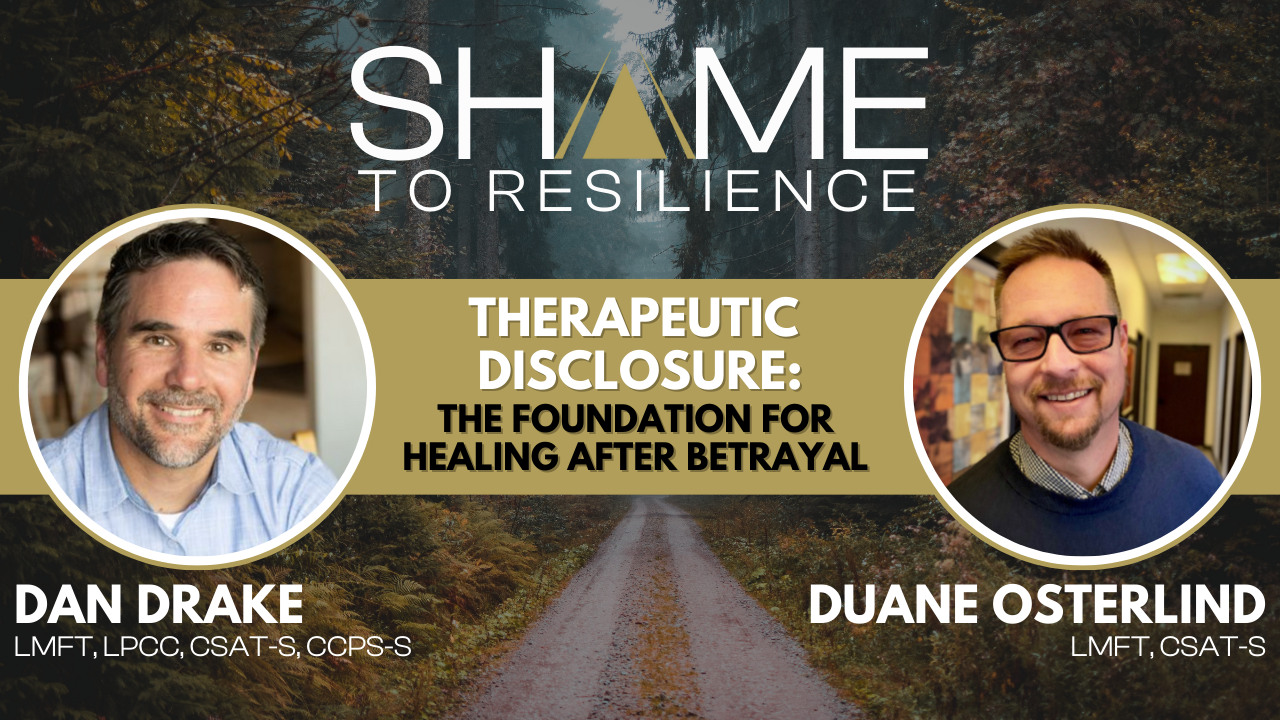
Healing After Betrayal: The Path of Disclosure

When the reality of your relationship shatters, finding a way forward can feel impossible. But true healing begins with a single, brave step: bringing the truth into the light. In our latest post, we explore the transformative power of Therapeutic Disclosure—a structured process designed not to punish, but to rebuild the broken foundation of trust.

We dive into the "pyramid of intimacy" and explain why staggering the truth only deepens the wound. Whether you are the one carrying the weight of a secret or the one reeling from discovery, this journey from shame to resilience is difficult, but you don't have to walk it alone. Discover how facing the darkness can finally lead you both back to a place of safety, honesty, and genuine connection.

[Read the full blog post to understand the steps toward healing.]
When trust is broken in a relationship, the world can feel like it has shattered. The discovery of betrayal often leaves a person feeling lost, confused, and questioning their own reality. It’s a deeply painful experience, one that can make the path forward seem impossible. But there is a way to begin rebuilding, a process that, while difficult, can create a new and more honest foundation for the future. This journey often starts with disclosure.

In a recent episode of Shame to Resilience, we explored the complex and essential role of therapeutic disclosure in healing from betrayal trauma. This process is more than just confessing; it's a structured and supported way to bring the truth into the light, allowing both partners to start fresh.

Understanding the Purpose of Disclosure

After the shock of discovering infidelity, the betrayed partner is often left with a fragmented reality. Disclosure is about piecing that reality back together. It’s not about punishing the person who was unfaithful, but about rebalancing the relationship and creating a new starting point built on truth.

Think of it as building a pyramid of intimacy. The foundation of this pyramid is honesty. Without it, nothing else can stand. From honesty, we can begin to build safety, then trust, and eventually, we can work our way up to true vulnerability and intimacy. Staggered confessions or trickle-truthing—where details come out a little at a time—constantly chip away at this foundation, making it impossible to build anything lasting. Therapeutic disclosure aims to lay all the facts out at once, creating a solid base to move forward from.

The Process of Therapeutic Disclosure

Therapeutic disclosure is not a simple conversation. It's a carefully prepared process that honors the pain of the betrayed partner while supporting the person who was unfaithful in taking full responsibility. As discussed in the episode, this process, guided by professionals, can take six to eight weeks of preparation.

For the person who has been unfaithful, this involves:

  • Writing a detailed history: This includes creating a timeline of the betrayal and investigating the behaviors without minimizing or justifying them.

  • Confronting internal narratives: The preparation phase involves multiple revisions to remove any blame-shifting, gaslighting, or rationalizations. It's about facing the truth of one's actions.

  • Preparing for the emotional impact: The goal is to present the information in a way that the betrayed partner can hear, while also preparing for the intense emotions that will follow.

For the betrayed partner, preparation involves getting ready to receive information that will be painful but will ultimately validate their intuition and reclaim their sense of reality. The truth, even when it hurts, is often less damaging than the continued deception and lies.

The Emotional Aftermath: A Post-Operative Period

Disclosure is not the finish line; it’s a new starting line. The period immediately following disclosure can be incredibly challenging. It can be compared to the post-operative period after major surgery. Things will likely feel worse before they start to get better.

The person who was unfaithful often experiences a mix of immense relief from no longer carrying the secret, alongside a deep terror of the consequences. For the betrayed partner, this is when the true grieving process begins. They are now processing the full scope of the betrayal and mourning the relationship they thought they had.

It is in this tender, post-disclosure phase that the real work of rebuilding begins. It requires patience, professional support, and a commitment from both individuals to navigate the pain together.

The Role of Shame in Healing

A powerful force that keeps betrayal hidden is shame. Secrecy and hiding only reinforce shame, creating a cycle that is incredibly difficult to break. Disclosure, on the other hand, is an act of bringing shame into the light. Through sharing and taking responsibility, healing can begin.

This is a profound experience for the person who was unfaithful. Confronting their shame is often one of the most significant benefits of the disclosure process, allowing them to move toward genuine change.

But shame isn't limited to one person. The betrayed partner may also experience shame—shame for not seeing the signs sooner, or shame for choosing to stay in the relationship. Acknowledging and working through these feelings is a critical part of their healing journey as well. Disclosure helps the betrayed partner reclaim their reality, validating that what they suspected was real and allowing them to trust their intuition again.

Find a Path Forward

The journey through betrayal is one of the most difficult challenges a relationship can face. But you don't have to walk it alone. The process of disclosure, when done with professional help and support, can be a transformative step toward healing and creating a relationship grounded in honesty and respect. It offers a chance to not just repair what was broken, but to build something entirely new.

To gain a deeper understanding of this process and hear more about navigating the emotional complexities of disclosure and the path from shame to resilience, we invite you to watch the full episode on our YouTube channel.

Duane Osterlind, LMFT, CSAT-S

About the Author

Duane Osterlind, LMFT, CSAT-S

Licensed Marriage & Family Therapist  ·  Certified Sex Addiction Therapist Supervisor  ·  Founder & Clinical Director, Novus Mindful Life Institute  ·  Licensed in CA, FL, TX, VA & ID

Duane Osterlind is a therapist with over 15 years of experience helping men recover from infidelity, sex addiction, and betrayal trauma. He is the founder and clinical director of Novus Mindful Life Institute, where he leads a clinical team specializing in sex addiction and betrayal recovery. He is also the co-founder of Shame to Resilience and host of The Addicted Mind Podcast. His clinical work centers on the Compass of Shame framework and building shame resilience so that empathy — the essential ingredient for relationship healing — becomes possible.

Read More

Why Betrayal Trauma Feels Like PTSD (Because It Actually Is)

If you’ve discovered your partner’s betrayal and feel like you’re losing your mind, I want you to know: you aren't crazy. You're injured. Research shows that 60-70% of betrayed partners meet the criteria for PTSD, meaning your sleepless nights and intrusive thoughts aren't "drama"—they are legitimate responses to a traumatic brain injury.

In this post, we explore the neuroscience behind your pain, explaining why your "alarm system" is stuck in overdrive and why you can't just "get over it." But more importantly, we discuss neuroplasticity and the scientific proof that your brain can heal. Recovery is possible, and it starts with understanding that your reaction is a normal response to an abnormal situation. Read on to find validation, science-backed insights, and a roadmap back to yourself...

If you have discovered your partner's infidelity or sexual betrayal, you might feel like your world has tilted on its axis. You can’t sleep. You can’t eat. You find yourself obsessively checking their phone or tracking their location. You might be having panic attacks or feeling a rage you’ve never known before.

And perhaps the most frightening thought creeping in is: "Am I losing my mind?"

I want to look you in the eye—metaphorically speaking—and tell you something crucial: You are not crazy. You are not "being dramatic." You are experiencing a legitimate, physiological response to trauma.

Research indicates that between 60% and 70% of partners who experience betrayal meet the full clinical criteria for Post-Traumatic Stress Disorder (PTSD). What you are feeling isn't just heartbreak; it is a traumatic brain injury. Understanding this biological reality is the first step toward compassion and healing.

Download The Worksheet

Betrayal is Trauma, Not Drama

When we think of PTSD, we often picture combat veterans or survivors of physical accidents. But emotional betrayal by an intimate partner strikes at the very core of our survival instincts. We are wired for connection. When the person who is supposed to be your safe harbor becomes the source of danger, your brain’s safety systems go haywire.

It’s heartbreaking to see so many betrayed partners blaming themselves for their inability to "just get over it." You might wonder why you’re still triggering months later, or why you can't stop asking the same questions.

This isn't a character flaw. It’s neurology. Just as you wouldn’t expect a broken leg to heal in a week by simply "thinking positive," you cannot expect a traumatized brain to snap back to normal overnight. Recovery takes time—often 18 to 24 months for acute symptoms to stabilize, and 3 to 5 years for full integration.

That timeline might sound daunting, but knowing it can be a relief. It means you aren't failing at recovery; you are right on schedule for a major injury.

Your Brain on Betrayal: The Three Key Players

To understand why you feel this way, we need to look at three specific regions of your brain that are profoundly affected by trauma.

1. The Amygdala: The Alarm System

The amygdala is your brain's threat detection center. It’s like a smoke detector scanning for danger. When you discover betrayal, this alarm gets stuck in the "ON" position. It becomes hyperactive and sensitized.

This is why you feel constant anxiety, hypervigilance, and that jittery sensation that you can never truly relax. Your body is flooded with stress hormones like cortisol and adrenaline, keeping you in a perpetual state of fight, flight, or freeze. You aren't being paranoid; your nervous system is desperately trying to protect you from another surprise attack.

2. The Hippocampus: The Memory Center

The hippocampus is responsible for processing memories and filing them away as "past events." When trauma hits and cortisol floods your brain, the hippocampus gets impaired. It stops filing properly.

This results in intrusive flashbacks, nightmares, and obsessive rumination. Your brain is trying to process an event that feels too big to file away. Instead of becoming a dusty memory on a shelf, the trauma stays on your mental desktop, open and active. This is why you replay details over and over—your brain is trying to make sense of a narrative that has been shattered.

3. The Prefrontal Cortex: The CEO

This is the part of the brain responsible for logic, emotional regulation, and decision-making. During trauma, blood flow and energy are diverted away from this "thinking brain" and sent to the "survival brain" (the amygdala). Your inner CEO essentially goes offline.

This explains the "brain fog," the difficulty concentrating, and the emotional mood swings. If you feel like you don’t recognize yourself—like you’ve lost your ability to be calm or rational—it’s because your executive function is temporarily impaired.

The Six Core Trauma Responses

Once we understand the brain science, your behaviors start to make a lot more sense. These aren't symptoms of being "controlling" or "weak"; they are the six core responses to betrayal trauma.

  1. Hypervigilance: Scanning for threats, checking phones, monitoring bank accounts. This is your amygdala screaming for safety.

  2. Intrusive Thoughts: Flashbacks and obsessive thinking. This is your hippocampus struggling to process the reality of what happened.

  3. Avoidance: Staying away from places, songs, or shows that remind you of the betrayal to avoid pain.

  4. Emotional Dysregulation: Intense mood swings, rage followed by despair. Your prefrontal cortex is struggling to regulate your feelings.

  5. Dissociation: Feeling numb, foggy, or like you are watching your life from the outside. This is your brain's way of distancing you from overwhelming pain.

  6. Functional Impairment: Struggling to work, parent, or take care of daily tasks.

If you see yourself in this list, take a deep breath. You are reacting exactly as a human brain reacts to deep trauma.

Why This Reframe Changes Everything

Why does it matter that we call this trauma? Why not just call it a "relationship issue"?

Because understanding this as a brain injury changes how you treat yourself. It allows you to trade shame for self-compassion. Instead of beating yourself up for checking his phone again, you can say, "My amygdala is terrified right now and looking for safety."

It also changes how you approach treatment. You wouldn't treat a broken bone with a band-aid. Trauma requires trauma-informed care—individual therapy, nervous system regulation, and safety—before effective couples counseling can usually begin.

Most importantly, it validates your pain. You aren't overreacting. You are injured.

Hope: Your Brain Can Heal

I want to leave you with the most important piece of science: Neuroplasticity.

Neuroplasticity is your brain's amazing ability to rewire itself. The damage caused by betrayal is not permanent. With the right support, safety, and time, your amygdala can learn to stand down. Your hippocampus can file these memories away where they belong—in the past. Your prefrontal cortex can come back online, restoring your sense of self.

You can heal. You can trust your gut again. You can feel joy again.

Recovery is a marathon, not a sprint. But every time you offer yourself kindness instead of judgment, every time you reach out for safe support, you are helping your brain repair those pathways. You are moving from brokenness toward resilience.

Need more support?
If you are struggling with the symptoms of betrayal trauma, you don't have to do it alone.

Meta Title: Why Betrayal Trauma Feels Like PTSD: Understanding Your Brain
Meta Description: Discover why betrayal trauma feels like PTSD. Learn about the brain's trauma response, the amygdala hijack, and why you aren't "crazy"—you're injured.

Duane Osterlind, LMFT, CSAT-S

About the Author

Duane Osterlind, LMFT, CSAT-S

Licensed Marriage & Family Therapist  ·  Certified Sex Addiction Therapist Supervisor  ·  Founder & Clinical Director, Novus Mindful Life Institute  ·  Licensed in CA, FL, TX, VA & ID

Duane Osterlind is a therapist with over 15 years of experience helping men recover from infidelity, sex addiction, and betrayal trauma. He is the founder and clinical director of Novus Mindful Life Institute, where he leads a clinical team specializing in sex addiction and betrayal recovery. He is also the co-founder of Shame to Resilience and host of The Addicted Mind Podcast. His clinical work centers on the Compass of Shame framework and building shame resilience so that empathy — the essential ingredient for relationship healing — becomes possible.

Read More

The Shame of Staying: Healing from Betrayal Trauma

If you’ve chosen to stay after a betrayal, you might be battling a heavy, silent shame. Society says strong people leave, but the reality is far more complex. In this post, we explore why you aren't foolish for staying and how to navigate the crushing weight of self-blame. Discover how to reclaim your power, set boundaries, and move from brokenness to brave on your healing journey.

When a partner cheats, society often sends a clear message: a strong person leaves immediately. But reality is far more complex. Most people actually stay, and if you're choosing to work on your relationship, you might be battling a crushing wave of shame. It’s a silent struggle, an internal conflict layered on top of the initial shattering pain of betrayal.

This feeling is something I see often in my work, a heavy burden that isolates people when they need connection the most. To explore this difficult topic, I recently spoke with Tammy Gustafson, a licensed professional counselor, coach, and the host of the annual Betrayal Healing Conference. Tammy brings a unique and powerful perspective; she was a trauma therapist for years before experiencing her own discovery of betrayal. She understands both the clinical theory and the personal, gut-wrenching pain.

In our conversation, we dove into the nuanced layers of shame that partners face and, more importantly, the path toward healing and empowerment.

Download the Worksheet

The External Pressure: "Why Don't You Just Leave?"

One of the first sources of shame comes from the outside world. There's a prevalent, unspoken cultural script that says "happy people don't get cheated on" or "if you were a better partner, this wouldn't have happened." This narrative places an unfair burden on the betrayed partner, a form of victim-blaming that can be incredibly damaging.

As Tammy explained, many partners internalize these messages. They start to believe they are somehow at fault. Maybe they weren't attentive enough, affectionate enough, or "enough" in some other way. This self-blame is then compounded by the judgment—real or perceived—from friends, family, and society at large.

Before the betrayal, you may have even told yourself, "If my partner ever cheated on me, I'd be out the door." But when it actually happens, life isn't so simple. There are shared histories, children, finances, and a deep love that doesn't just vanish overnight. The decision to stay and work on the relationship is not a sign of weakness; it's a choice made amidst immense complexity and emotional turmoil. Yet, that choice is often met with a chorus of external and internal voices whispering, "You should be stronger. You should leave." This creates a profound sense of shame for simply trying to navigate an impossible situation.

The Internal Struggle: "How Could I Have Been So Stupid?"

Beyond the societal pressure, a deep internal shame often takes root. I hear this from clients all the time: "How could I have not seen this?" or "I feel like such a fool." This feeling is what some call "hindsight bias." Once the truth is revealed, all the little signs that didn't make sense before suddenly click into place, and it feels so obvious.

This can lead to a sense of self-betrayal. You start to question your judgment and your reality. But it’s crucial to understand: you are not stupid or foolish. You were in a relationship with a fundamental agreement of trust. That agreement was broken unilaterally by someone who was likely using deception and gaslighting to hide their actions. You didn't see it because it was actively being concealed from you.

As Tammy shared from her own experience, even as a trained therapist, she felt this sting of "I should have known." It’s a common and powerful part of the trauma. This internal narrative can lead to isolation, as the shame makes you want to hide from the world, and even from yourself.

The Path to Healing: From Shame to Empowerment

So, how do you begin to move through this sticky, persistent emotion of shame? The journey is not quick or easy, but it is possible. It involves shifting your focus, reclaiming your power, and extending compassion to yourself.

1. Reassigning Responsibility

The first step is to place the responsibility for the betrayal where it belongs: on the person who made the choice to betray. As Tammy and I discussed, no matter what was happening in the relationship, there were countless ways your partner could have addressed their dissatisfaction or personal struggles without breaking their commitment. Their choice to step outside the relationship was 100% their own.

You were not perfect—no one is. But you did not cause this. Internalizing this truth is a foundational piece of healing. It allows you to stop carrying a burden that was never yours to hold.

2. The Power of Connection

Shame thrives in isolation. Its antidote is connection. One of the most powerful steps a betrayed partner can take is to connect with others who have gone through the same experience. In a group setting, you quickly realize you are not alone.

When you hear other intelligent, strong, and caring individuals share the same feelings of foolishness or self-blame, you can see how untrue that narrative is for them. It becomes easier to then see that it's untrue for you, too. Hearing "Of course you didn't see it, he was hiding it," from someone who truly understands can be the first crack of light that breaks through the shame.

3. Reconnecting with Your Identity

Betrayal can shatter your sense of self, and shame solidifies that feeling of being "broken" or "unworthy." A critical part of healing is reconnecting with your core identity. Remind yourself of who you are outside of this trauma. You are loving, you are strong, you are a person of value.

As Tammy beautifully put it, when we can get grounded in our own identity, we can start to "talk back to the shame." This isn't about ignoring the pain, but about refusing to let the shame define you. This shift is incredibly empowering and impacts not just your recovery from betrayal, but your entire sense of personhood.

4. The "All Ships Rise" Dynamic

In the chaotic aftermath of discovery, there’s often an unspoken battle over whose emotions get center stage—the betrayer’s regret or the betrayed’s pain. My experience, which Tammy confirmed, is that true healing for the relationship can only begin when the betrayed partner shifts the focus back to their own healing.

This means setting boundaries, prioritizing your safety (emotional and physical), and working on your own recovery. This act of differentiation is profoundly empowering. It also forces the betraying partner to confront their own shame, which is often the catalyst they need to begin their own genuine work. When the betrayed partner steps into their power, it creates the potential for all ships in the harbor to rise together. He can't show up with empathy for you if he is trapped in his own shame. By focusing on your healing, you inadvertently create the only real path for his.

Your Roadmap: From Broken to Brave

Navigating this journey can feel like falling through a black hole, with no sense of which way is up. This is why Tammy has poured her personal and professional experience into her upcoming book, Broken to Brave. She provides a roadmap for healing, breaking the journey down into distinct phases.

The book acts as a compassionate guide, helping you understand where you are in the process, what to focus on, and what to expect next. It gives you permission to feel what you feel and to take the path that is right for you. It’s a reminder that while the path is counterintuitive and difficult, you are not crazy, and you can make it to the other side.

Healing is not one single moment of arrival but a series of small steps. It's the hard conversation you have, the moment you are vulnerable in your support group, the day you stand up for yourself. Each step builds on the last, slowly moving you from a place of brokenness toward a future defined by your own strength and resilience.


It’s time for him to take the next step. If your partner is ready to move beyond shame, take true accountability, and start building the foundation for genuine healing, this workshop can guide him.

The Shame to Resilience workshop is designed to help men do the difficult work of confronting their actions and developing the empathy needed to repair the hurt they've caused. This is his opportunity to grow, and a chance for you both to build a new, stronger future.

Share this with him: https://workshop.shametoresilience.com/

Duane Osterlind, LMFT, CSAT-S

About the Author

Duane Osterlind, LMFT, CSAT-S

Licensed Marriage & Family Therapist  ·  Certified Sex Addiction Therapist Supervisor  ·  Founder & Clinical Director, Novus Mindful Life Institute  ·  Licensed in CA, FL, TX, VA & ID

Duane Osterlind is a therapist with over 15 years of experience helping men recover from infidelity, sex addiction, and betrayal trauma. He is the founder and clinical director of Novus Mindful Life Institute, where he leads a clinical team specializing in sex addiction and betrayal recovery. He is also the co-founder of Shame to Resilience and host of The Addicted Mind Podcast. His clinical work centers on the Compass of Shame framework and building shame resilience so that empathy — the essential ingredient for relationship healing — becomes possible.

Read More