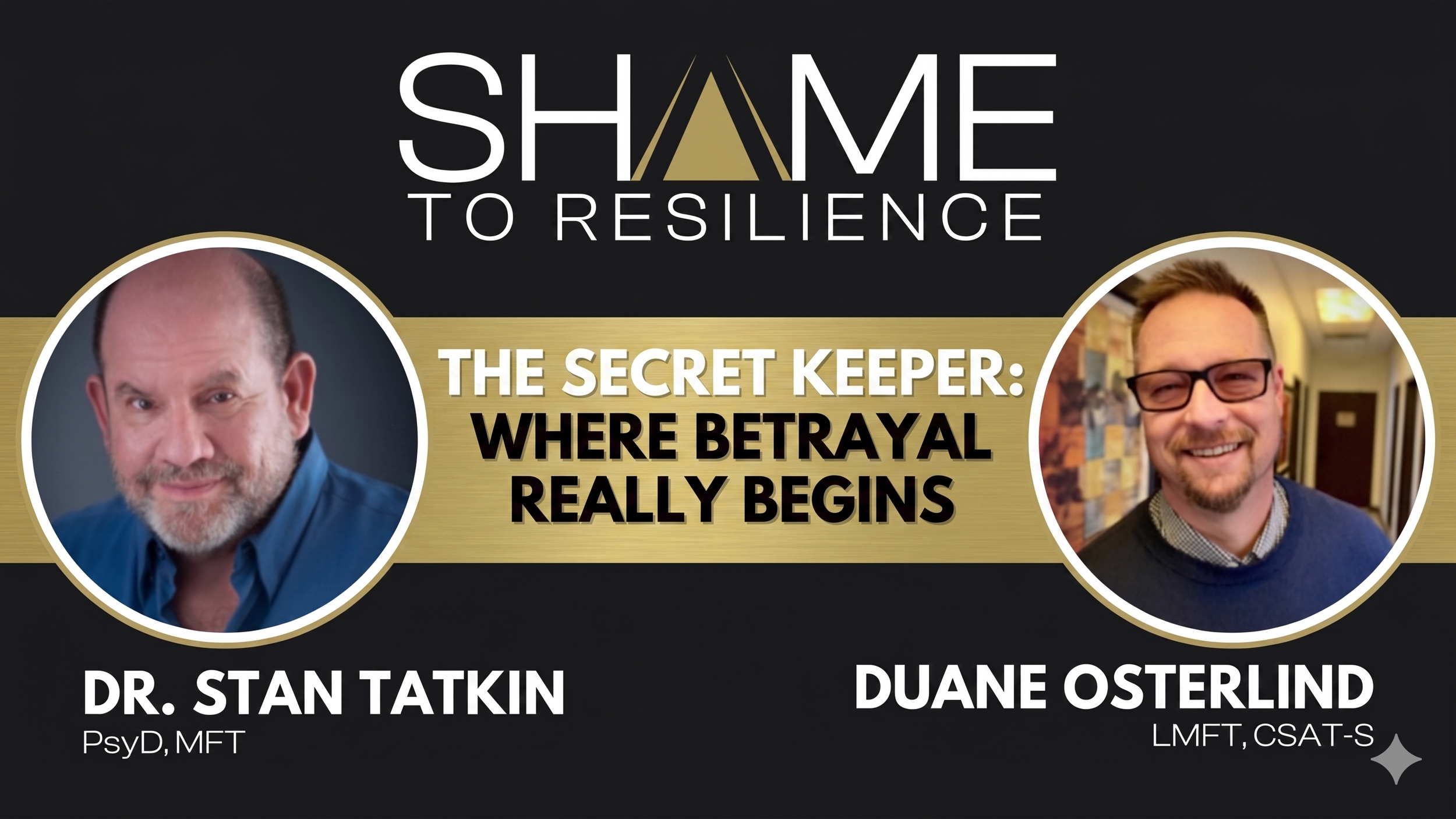
How He Sat Across From You Like Nothing Happened: Dismissive Avoidant Attachment and Secret Keeping
You replay the dinners and the vacations and wonder how he could sit there. Dr. Stan Tatkin on the attachment pattern underneath secret keeping — and why repair has to go deeper than a promise to be honest.
By Duane Osterlind, LMFT, CSAT-S
You keep replaying the dinners. The vacations. The Sunday mornings he passed the cream and asked about your day with a second life folded quietly inside him. And the part that won’t let you sleep isn’t only what he did. It’s that he could sit there. He could look at you. He could be there and not be there at the same time.
You’re not crazy and you’re not exaggerating. There’s a name for what you were sitting across from and it has its own developmental fingerprint.
In part three of my four-part series with Dr. Stan Tatkin — developer of PACT and author of Wired for Love and In Each Other’s Care — we trace the capacity for secret keeping all the way back to infancy. To something called dismissive avoidant attachment.
This isn’t an excuse. It’s a map. You can’t change what you can’t see, and neither can he.
The Pattern Underneath the Secrets
Most men who become long-term secret keepers don’t have a hundred different stories. They have one. Stan put it plainly: the large majority of these partners fall into the distancing group of insecure attachment — what clinicians call avoidant or dismissive avoidant. Almost across the board.
The behaviors you experienced weren’t random. The moral equivalencies. The flash of anger when you asked a simple question. The hesitation, the half-truth, the carefully arranged silence. They map back to a very specific origin story and once you see the shape of it the chaos starts to make a different kind of sense.
If you want a primer on why honest answers alone don’t actually rebuild trust, I unpack that in Why Transparency Isn’t Enough After Betrayal.
What Dismissive Avoidant Attachment Actually Looks Like
A securely attached baby has at least one adult who is genuinely interested in their inner world. Skin to skin. Eye to eye. Curious about what’s happening behind those tiny eyes and reliable about coming back when they leave the room.
When that’s missing the baby does one of two things. Some cling. They cry harder, reach further, melt down when mom walks out and won’t be soothed when she comes back. Others go the opposite way. They stop reaching. They stop tracking her across the room. They stop looking up when she walks in. The “pick me up, pick me up” gets quietly extinguished — not because the want isn’t there but because no one ever met it.
Those are the avoidant babies. They learn to play alone but it’s a thin, jerky kind of play. The caregiver doesn’t change so the trajectory doesn’t change either. The child’s distancing reliably pulls the same distance back out of the environment and the loop tightens. Researchers call this the strange situation and it’s been replicated for half a century.
This is the man who later sits across from you at dinner.
Why Secret Keeping Isn’t a Choice — It’s an Adaptation
Here’s the line every betrayed partner deserves to hear Stan say out loud. For these men, keeping the inside hidden isn’t just easier. It’s predicted.
The avoidant child learned early that there was no one to share with. So he spent more time alone. He learned to auto-regulate — a kind of self-soothing that doesn’t want or require another person. He got used to compartmentalizing because nobody was interested in the contents anyway. He lives in a hyper-focused inner world, the same neural territory you’d visit zoning into a movie or a game, except for him it’s not an occasional retreat. It’s the default.
Stan names something else that lines up with what we see clinically every day. This group tends to carry more shame than the rest. More sexual secrets. More unspoken material. They also carry far more interpersonal stress than they’re aware of, which is why being in connection with you for long stretches actually costs them. It’s not that he didn’t love you. It’s that being with you was metabolically expensive in a way being alone never was.
If you’ve felt invisible in your own marriage, that’s part of what you were bumping into. For more on how his nervous system pulls away from you the moment you’re in pain — and what that does to your brain — read Your Defensiveness Is Re-Traumatizing Your Partner’s Brain.
The Fantasy Bond: Why His “Love” Could Feel So Lonely
Stan references something the psychologist Robert Firestone called the fantasy bond. You can read more about Firestone’s work at The Glendon Association. The fantasy bond is what an avoidant child builds when real connection isn’t on offer — an internal stand-in for attachment that feels like love but functions like a closed loop. He makes it secure in his head because it was never secure in real life.
Carried into adulthood, it shows up in ways that sting if you’re the one in the room with him. He treats you like a self-object. He expects you to feel what he feels, want what he wants, see what he sees and when you don’t it lands like an attack. Disagreeing about a movie can feel like betrayal to him. You come home from a hard trip and he describes it as great — not because he’s gaslighting you but because he wasn’t actually with you. He was playing alone in his head the whole time.
Sex can feel like you’re interchangeable. Like it could be anyone. Because in some real sense he’s auto-regulating, not relating.
None of this softens what he did. It explains why “just tell me everything from now on” feels almost biologically impossible for him, and why repair has to go much deeper than a promise to be honest.
The Hardest Part of Recovery: Letting the Old Relationship Die
Now lay all of that over what’s happening between you right now.
When you finally say, with your whole body, “I’m out — go fix this and maybe you come back to me,” his system spikes. You may not see it. It often happens internally. The very thing he’s quietly leaned on as his secure base is revoking that status and his inner world rearranges fast.
This is the moment Stan calls out without flinching: the relationship you had is over as you thought it was. It can’t be the same. It has to be a complete rebuild. Anything less is theater.
That’s not a threat. It’s the actual scope of the work. Trying to glue the old marriage back together is what keeps couples stuck for years. The path forward is a different relationship between two changed people and that starts with him owning what shaped him without using it as a hiding place.
If you want a concrete picture of how trust gets rebuilt — one repeatable action at a time — read 3 Actions That Build Safety After Betrayal. Paired with this episode, those two practices carry most of the load.
What This Means for the Man Who Kept the Secrets
If you’re the partner who kept things hidden, this may be the first time someone has described your inner life back to you in a way that lands as accurate instead of accusing. Stay there for a second. Don’t run.
You did not choose dismissive avoidant attachment. You inherited an adaptation that worked very well when you were small and very poorly inside an adult relationship. That’s a real thing. It’s also not a shield. The harm is yours. The repair is yours. The accountability is yours.
The good news from Stan’s body of work is that adaptations can be updated. Brains keep adapting across the lifespan. What it takes is the willingness to do the actual work and the willingness to let this relationship be rebuilt rather than rescued. Those are two different jobs.
Catch Up on the Series
This is part three of a four-part conversation with Dr. Stan Tatkin. If you missed the earlier episodes, start with the neuroscience and then move into how boundaries actually work.
Part 1: What Betrayal Actually Does to Your Brain
Part 2: Boundaries After Betrayal — Why “Good Faith Effort” Is the Only Path Forward
A Word Before You Close This Tab
If you’re the betrayed partner reading this, you don’t have to decide anything today. You don’t have to forgive. You don’t have to stay. You don’t have to leave. You’re allowed to take the time your nervous system needs and you’re allowed to ask for the real thing — not the performance.
If you’re the man who caused harm, the next right step isn’t a grand gesture. It’s getting honest about the adaptation that’s been running you and getting real support to interrupt it. That’s slower work than most men want it to be. It’s also the only work that holds.
When you’re ready to look at what that work actually looks like in community with other men doing it, the Shame to Resilience workshop is one place to start. No pressure and no countdown. Just a door, open when you’re ready to walk through it.