
Toxic Shame vs. Healthy Shame After Cheating: Why His Shame Isn't the Same as Remorse
Maybe he says it out loud. I'm broken. I'm a horrible person. I hate myself. You should just leave me. And then that look — can't you see how bad I feel about this?
Or maybe he doesn't say anything at all. He's standing there silent, looking at the floor, and you can tell he's thinking every one of those things. He just won't say them.
And you're across from him, your own world just came apart, and some part of you is asking a question you may even feel guilty for asking: Is this his remorse? Or is this something else? Is this about my pain — or is this about his?
That question is the difference between toxic shame and healthy shame after cheating. And they can look almost identical in the first weeks. Same heaviness. Same I'm so sorry. Same silence.
I'm Duane Osterlind. I'm a Licensed Marriage and Family Therapist and a Certified Sex Addiction Therapist Supervisor, and for a long time now I've sat with couples on both sides of betrayal. What I see over and over is the betrayed partner trying to read him. Is he actually sorry for what he did to me? Or is he drowning in how he feels about himself? Those are two very different things. And the difference decides a lot about whether this can heal.
One thing before we start, said plainly. I work mostly with men who have betrayed their partners, so that's usually who I'm talking to. But betrayal by a woman is every bit as devastating, and if you're a man who was betrayed, you get a lot less room to say so. Everything I describe below about the one who broke trust is about her too. If you want to send this to her, send it.
Why we feel shame at all
Shame is a social emotion. We don't feel it alone. We feel it in the eyes of other people — or in the eyes we imagine.
There's a reason for that. For most of human history, being pushed out of the group was a death sentence. So we developed a signal that fires when something we're about to do, or just did, wouldn't be good for the people we belong to. When it puts your belonging at risk, that signal is shame. The dropped eyes, the flush, the wanting to get small. Silvan Tomkins and Donald Nathanson mapped shame as one of our built-in affects, and a deeply social one.
Then John Bradshaw added the piece I find most helpful. He said healthy shame is the emotion that gives us permission to be human. It tells us we have limits. That we're not God. That we're not the center of everything. That we can and will make mistakes, and that we need help.
So healthy shame is actually a boundary. A container. It puts an edge around our behavior. It's the thing that tells us when to stop, when to say no. That's protective, and we need it.
The trouble starts when shame stops being a signal about our limits and fuses with who we are. When it's no longer I'm human and I make mistakes. When it becomes I am a mistake.
Toxic shame vs. healthy shame
I know "healthy shame" sounds strange. But there really is a healthy kind.
Healthy shame is the feeling of being human, of having limits. It says: I'm human. I have limits. I can and will make mistakes — and mistakes can be remedied. It's the wince that sends you back to repair. It's proportional. It keeps you inside your boundaries, and it keeps you connected, because part of what it says is I need other people.
Toxic shame is a different thing altogether. This is what Bradshaw was really getting at — shame that stops being a feeling that comes and goes and becomes a state of being. A core identity.
Healthy shame says I'm human, I can and will make mistakes. Toxic shame says I am the mistake. Broken. Defective. Unlovable. Bradshaw had a word for it: irreparable. Nothing can be done about it. I'm hopeless. I'm fundamentally broken. Not something I did — something I am.
Here's what matters for what you're seeing in your living room. Healthy shame keeps you connected to the other person: I hurt you. I need you. Toxic shame points at the self, and it points so hard it can't see anyone else in the room.
And toxic shame is unbearable. I am the mistake is not a feeling a person can just sit in. So we don't sit in it. We escape it — that's a big part of addiction — or we defend against it. And the way we defend against shame is pretty predictable.
The Shame Compass after cheating: four ways he defends against it
Donald Nathanson mapped this, and he called it the Compass of Shame. I walk through the whole thing in the Toxic Shame in Relationships post, and the Shame Compass e-book is built on it. The short version: when shame hits, we land somewhere on the compass, and there are four directions.
Withdrawal. He goes silent. He goes away without leaving. Stares at the floor, won't look at you. If you could hear what's running inside, it sounds like maybe I'm too broken for this. She doesn't deserve me. I don't deserve to be loved. Underneath it is one deep wish: to not be seen. To stay hidden.
Attack self. This is the loud one. I'm broken. I'm a horrible person. I hate myself. You should just leave me. And then that look — can't you see how bad I feel? Shame turned inward and turned all the way up.
Avoidance. Can we not do this tonight? I've got an early morning. The subject changes. The phone comes out. The drink, the work, the joke that lands wrong. Shame refusing to feel.
Attack other. Well, if you'd ever actually been there for me. Or: Why do you keep bringing this up? Are you trying to punish me? Shame thrown at the person who was already hurt.
Four directions. Four defenses. And I want to be careful here, because the pain underneath every one of them is real. I'm not saying any of it is an act — oftentimes it isn't. But notice something. Toxic shame is, at its core, a deep sense of unworthiness. There's no healthy pride in it. None of that quiet I can do hard things. I can face this. I can repair. It's I am not enough to be in this room.
So every one of those four moves is a way of leaving the room. Even when he's sitting right there.
Why each direction gets misread
Here's the trap: each direction tells you something that isn't quite true.
Attack self gets misread as remorse. Look how much he's hurting. He must get it. That's the one I called the self-punishment show in the Regret vs. Remorse post. It looks like accountability. It isn't — not yet. Listen to the direction of the sentences. I'm broken. I hate myself. Can't you see how bad I feel? It's I, I, I. The person who was betrayed isn't in a single one of them.
Withdrawal gets misread as not caring. He's cold. He's checked out. He won't even look at me. And she's left alone with the pain, and now the loneliness on top of it — when underneath, he's so convinced he's unworthy of her that he can't let her see him. That's not nothing. But it's not remorse either.
Avoidance gets misread as he's already moved on.
Attack other — well, that one she usually doesn't misread. That one she feels.
So she's standing there trying to read him, and every direction on the compass is lying to her a little. Here's what's true about all four: every one of them is a defense against being seen. And not one of them is turned toward her.
Why toxic shame looks like remorse — and the tell
Remorse comes toward you. Shame — loud, quiet, slippery, or sharp — goes away from you. It turns away.
So here's the tell.
Watch who ends up doing the comforting.
Her world just got shattered. And twenty minutes into the conversation, she's soothing him. Her pain left the room. He took the chair.
That's what toxic shame does. It pulls the comfort toward itself. It has to — it's drowning. And a person who's drowning can't hold anybody else's pain. They can't.
Shame vs. guilt: the engine underneath
Here's the clinical piece, and I think it helps more than anything else here. Underneath toxic shame and healthy remorse are two different engines.
Toxic shame is a global evaluation of the self. I am bad. When somebody is flooded with it, being seen feels like a survival threat — literally, the nervous system goes into fight or flight. So you get the compass: hiding, collapsing, numbing, attacking. Every direction we just walked through.
Guilt is different. Guilt is about the behavior. I did something that hurt you. That was wrong. And because guilt separates what I did from who I fundamentally am, it doesn't collapse me. It mobilizes me — toward the person I hurt, toward repair.
Toxic shame runs on the first engine. Healthy remorse runs on the second. I go deeper on this in the Regret vs. Remorse post.
And here's the hopeful piece. Guilt and healthy shame can coexist with remorse. They're part of it. The wince is part of it. What can't coexist with remorse is the shame that swallows a person whole — because when there's no one left in the room, there's no one left to repair anything.
What healthy remorse actually looks like: the center of the compass
Healthy remorse is other-oriented. It's a deep, attuned sorrow about what the other person is going through because of my actions — not about what I'm going through.
It stays in the room. When the hard question comes — the same question, the hundredth time — remorse doesn't collapse and it doesn't defend. It stays. It regulates. It turns toward.
It's proportional. The pain fits the harm. It's heavy — it should be heavy — but it isn't bottomless, and it isn't a performance. And it moves toward repair. Not toward being forgiven. Toward repairing. Those aren't the same thing.
Remorse asks: What does she need? What's mine to carry? What would make this safer for her? Toxic shame asks: How do I make this feeling stop?
And here's how it fits the compass. Healthy remorse is not a fifth direction. It's the center. It's the man who feels the shame hit — and it does hit, it should — and doesn't take any of the four exits. He stays at the center. Present. Accountable. Turned toward her. That's what I called true north in the Toxic Shame in Relationships post. This is what true north looks like after cheating.
Toxic shame says: I am the problem. Healthy remorse says: I caused a problem, and I'm going to repair it.
That's the whole difference, really. One sentence is about identity. The other is about responsibility. And you can only repair from the second one.
The compass vs. the center: four moments
Healthy remorse isn't a fifth direction. It's the center. Here are four moments you'll recognize — where he lands, and what staying at the center looks like.
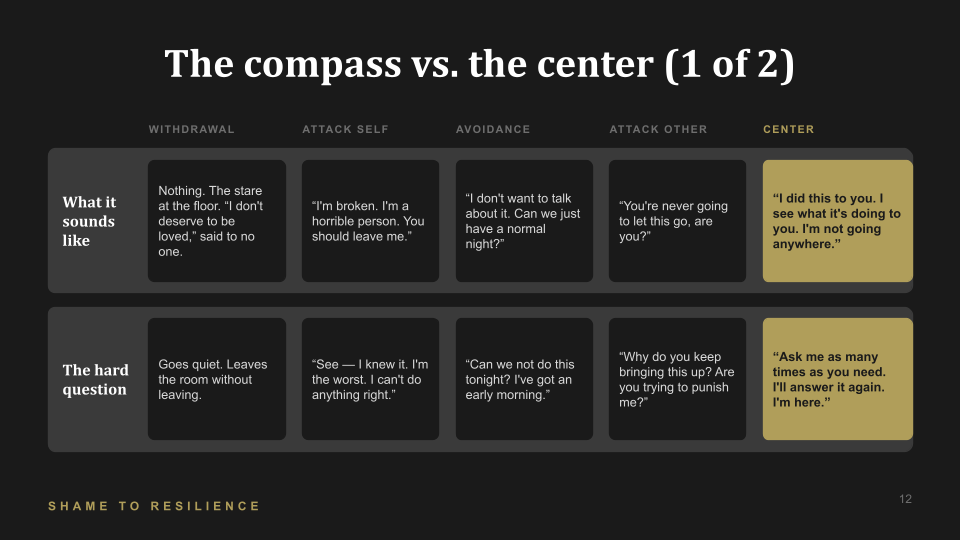
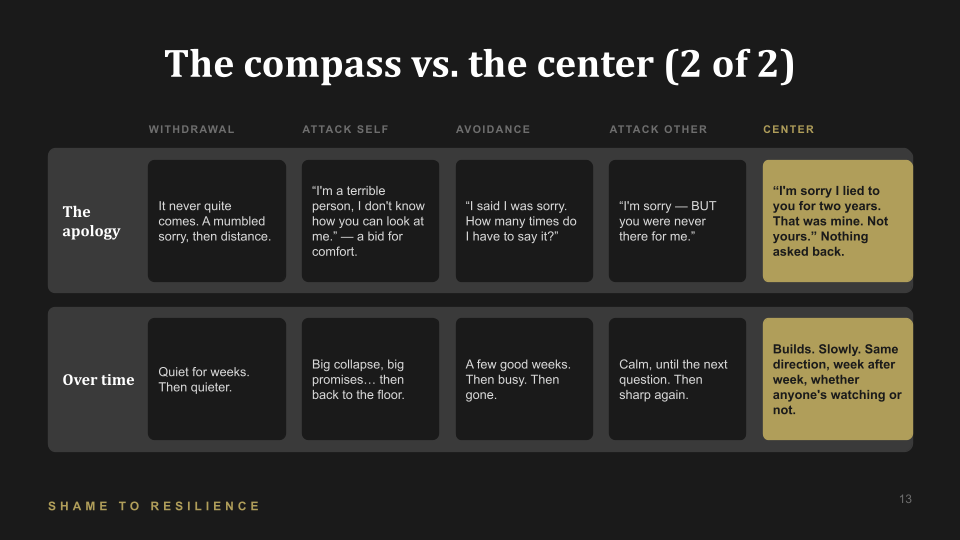
The four directions all cycle. Round and round, back to whatever exit he knows best. The center builds.
So if you're trying to read him, stop asking is he sorry? Ask where is he on the compass right now? And over weeks: is he finding his way back to the center — or is he finding a better exit?
Why toxic shame makes the next betrayal more likely
Toxic shame isn't just painful to be around. It's oftentimes the engine of the next betrayal.
Think about what shame demands: stay hidden. So the person drowning in shame hides the slip, hides the urge, hides the relapse — because if you already believe you're a monster, every mistake is just more proof, and more proof gets buried. And what gets buried grows. Shame, hide, secret, act out, more shame. Round and round.
There's research on this. Breines and Chen (2012) found that people who met their failures with self-compassion took more responsibility, not less — and were more motivated to repair the harm. Self-criticism did the opposite. It produced avoidance and hiding.
So I'll say this as plainly as I can. The person who hates himself the loudest is not necessarily the person who's changing. Oftentimes he's the one who's still hiding. Not because he's bad. Because he's drowning in his own shame.
If you're the one who was betrayed: three things
One. You don't have to rescue the spiral. When the self-punishment starts — I'm broken, I'm a horrible person, you should just leave me — you're allowed to not pick that up. You can say: I'm not going to talk you out of hating yourself right now. I need you to stay with what happened to me. That's not cruel. That's the most honest thing in the room.
Two. Name what you actually need. I don't need you to fall apart. I need you to stay. I need you to answer the questions. I need you to hear what this did to me without making it about how bad you feel. Give the direction. Remorse can follow a direction. Shame can't.
Three. Watch the direction, not the volume. Stop grading the tears. Stop grading the words. Stop grading the silence — too quiet reads the same as cold. Watch where he's pointed: toward himself, or toward you. Which direction did he go on the compass, and is he finding his way back to center? Is he coming toward you, even clumsily, or going away — louder or quieter? Over weeks, not over one night. Your eyes will start to see it. Your gut will too.
If what happened wasn't a single event but a pattern — months or years of a hidden life — the full guide to helping your wife heal after an affair holds the whole picture of what repair asks for.
If you're the man who did this
This part is for you.
I know some of you are reading this and the shame is already turning up. Great. Now I'm bad at doing remorse. I'm doing that wrong too. That's the spiral, and it's starting right now. So let me say it differently.
The toxic shame is a part of you. It's not all of you. It's a part that learned a long time ago that if anyone really saw you, they'd leave. So it hides. It splits things off. It builds compartments. And maybe right now it's telling you: I'm too broken for this. She deserves better than me. I should just disappear.
I want you to notice something about that voice. It sounds humble. It isn't. Bradshaw had a hard line on this: the hopeless one is grandiose too. I'm the sickest of the sick. Nothing and no one could help me. That's the same hiding, just wearing a quieter costume. And that part did real damage.
There's another part of you reading this — the part that wants to be a whole man. Congruent. The good and the bad, the dark and the light, all of it in one room.
Here's something I don't think gets said enough. Toxic shame strips out healthy pride. Not arrogance — healthy pride. The quiet, grounded sense of I am capable. I can do hard things. I can face what I did and still be a man worth something. You need that to repair. You can't show up for her pain if you don't believe you're capable of showing up. So some of this work is actually rebuilding worth — not so you feel better, but so there's something solid enough in the room to do the repair.
Self-compassion is not letting yourself off the hook. It's the thing that keeps you on the hook. Because a man drowning in shame leaves the room. He collapses, he defends, he goes silent, he hides. A man who can be kind enough to himself to stay — stays. And staying is where repair happens.
So the work isn't to hate yourself harder. You've tried that. We all have. It doesn't produce change. It produces hiding. The work is to move from I am the problem to I caused a problem and I'm going to repair it. From shame to guilt. From collapse to remorse. From wherever you land on the compass back to the center. Not because the shame stops hitting — because you stop taking that exit.
And here's what I want you to know. She will eventually know the difference between a man who is all in on this work and a man who is drowning and asking her to save him. Not tonight. But over time, she will know.
You can't repair from the bottom of a shame spiral. You repair from the room you're in.
If you're stuck in that loop — his collapse, her rescue, round and round — the Shame to Resilience workshop was built exactly for that: helping men move from shame to real accountability, with a process to do it.
Frequently asked questions
What is the difference between toxic shame and healthy shame?
Healthy shame is proportional and temporary. It says I'm human, I have limits, I can and will make mistakes — and it keeps you connected to the people you need. Toxic shame has fused with identity. It says I am the mistake: broken, defective, irreparable. Healthy shame is a boundary around behavior. Toxic shame is a verdict on the self, and it's unbearable enough that people escape it or defend against it rather than feel it.
Why do humans feel shame in the first place?
Shame is a social emotion. For most of human history, being pushed out of the group was fatal, so we developed a signal that fires when something we did, or are about to do, threatens our belonging. The dropped eyes and the urge to get small are that signal. Tomkins and Nathanson described shame as one of our innate affects, and Bradshaw called the healthy version "permission to be human" — it tells us we have limits and need other people.
Is toxic shame the same as remorse after cheating?
No, though they look alike in the first weeks. Toxic shame points at the self: I'm broken, I hate myself, you should leave me. Remorse points at the person harmed: I did this to you, I see what it's doing to you, and I'm going to repair it. Shame leaves the room — by collapsing, withdrawing, avoiding, or attacking. Remorse stays in it. Watch the direction, not the volume.
Why does he make it about himself when I bring up the affair?
Because he's flooded with shame, and shame is a global evaluation of the self. When being seen registers as a survival threat, the nervous system goes into fight or flight, and there's no room left to hold anyone else's pain. His self-focus isn't necessarily an act — he's drowning — but a drowning person can't hold your pain. That's why your pain leaves the room and you end up soothing him.
Why does he go silent and shut down instead of showing remorse?
That's withdrawal, one of the four directions on the Shame Compass. Underneath the silence is usually I'm too broken for this. I don't deserve to be loved. He's so convinced he's unworthy that he can't let you see him. It's easy to read as coldness, and it leaves you alone with the pain — but it's a defense against being seen, not an absence of feeling. It's also not remorse. Remorse comes toward you.
Is self-punishment after cheating a sign of remorse?
Not by itself. I'm a horrible person, I hate myself, you should just leave me is the attack-self direction on the Shame Compass, and it's the one most often mistaken for accountability. Listen to the sentences: they're all about him. Often they're a bid for comfort — tell me I'm not a monster. Real remorse is specific, other-focused, and asks nothing in return. Self-punishment is loud. Remorse stays.
What does healthy remorse look like after infidelity?
It's other-oriented — a deep, attuned sorrow about what you're going through because of his actions. It stays in the room when the same hard question comes the hundredth time. It's proportional: heavy, but not bottomless, and not a performance. Apologies are specific and clean, with nothing asked for in return. And it builds slowly over weeks, in the same direction, whether anyone is watching or not.
Can self-compassion help someone who cheated take more responsibility?
Yes. Breines and Chen (2012) found that people who responded to their failures with self-compassion took more responsibility and were more motivated to repair the harm, while self-criticism produced avoidance and hiding. Self-compassion isn't letting yourself off the hook — it's what keeps you on it. A man drowning in shame leaves the room. A man who can be kind enough to himself to stay is the one who can actually repair.
📥 Free download — the Shame Compass e-book
Every exit on the compass is a way of leaving the room while he's still sitting in it. Our free Shame Compass e-book breaks down the four ways shame shows up — withdrawal, attack self, avoidance, attack other — and how to find your way back to center. Download it free here.
Keep reading
Regret vs. Remorse After Cheating: How to Tell Which One You're Actually Seeing
Signs of True Remorse After Cheating
Why Your Apologies Aren't Landing: The Defensiveness Trap
